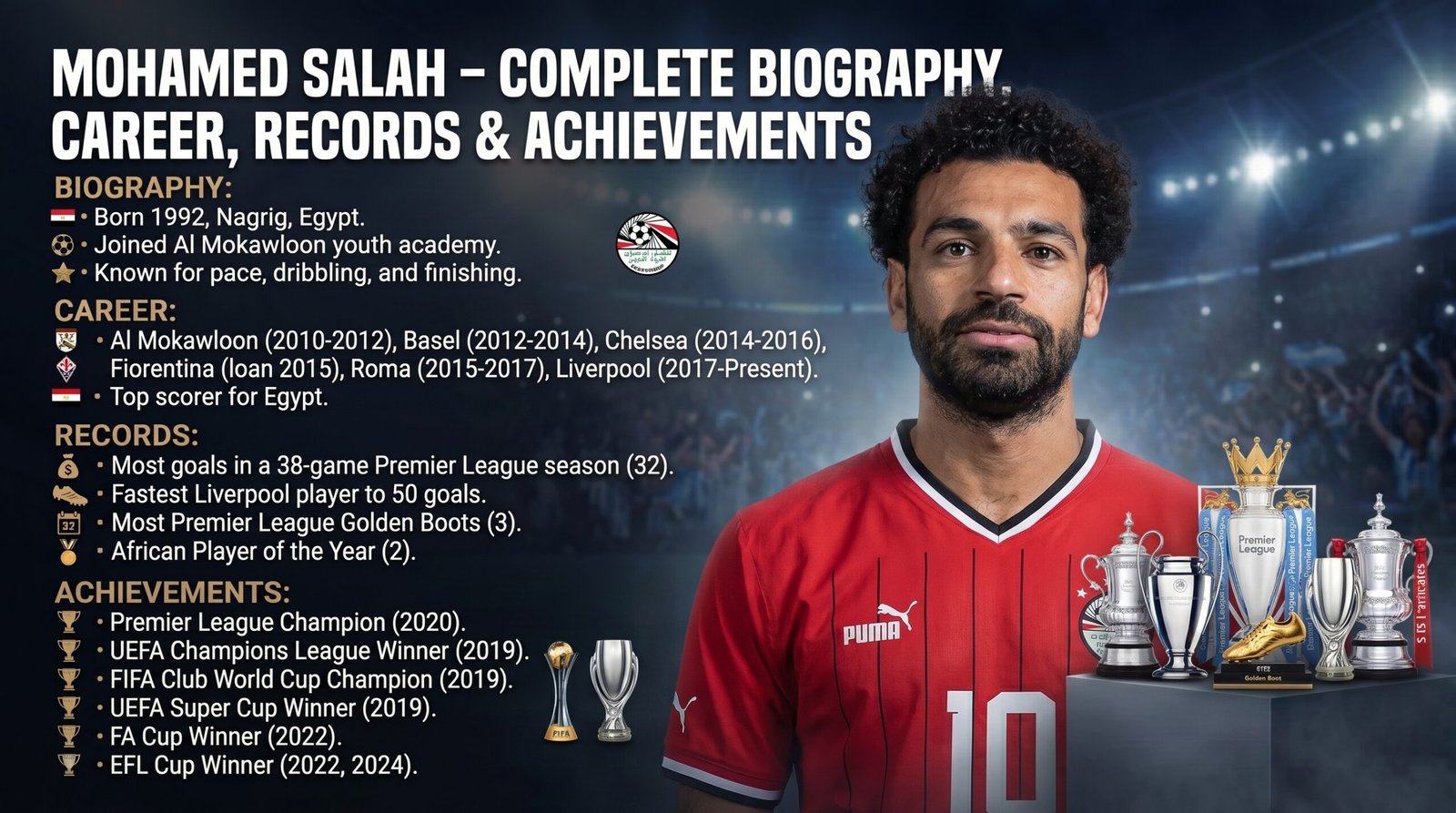
Introduction
Mohamed Salah Hamed Mahrous Ghaly is a name that commands reverence across the global footballing landscape. Universally affectionately known as the “Egyptian King,” Salah’s journey from the dusty pitches of a small farming village in the Nile Delta to the glittering pinnacles of European and world football is a narrative of extraordinary resilience, unwavering faith, and unprecedented athletic brilliance. He is not merely a football player; he is a transformational cultural icon who fundamentally altered the perception of Arab and Muslim athletes in Western media while simultaneously redefining the tactical parameters of the modern wide forward. Through his devastating pace, immaculate close control, and ruthless finishing, Salah became the definitive catalyst for Liverpool Football Club’s modern golden era, breaking individual records with an almost mechanical consistency.
As of the summer of 2026, Mohamed Salah occupies a highly unique space in world football. At 34 years of age, he is currently a highly coveted free agent, having mutually agreed to terminate his contract with Liverpool a year ahead of schedule, bringing a deeply emotional close to an illustrious nine-year chapter at Anfield. His departure followed a historic era where he amassed 255 goals in 435 appearances, securing his place as the club’s third all-time leading goalscorer. Yet, his story is far from over. In July 2026, he led the Egypt national team on an unprecedented, historic run to the knockout stages of the FIFA World Cup in North America, defying the odds and proving that his competitive fire and sheer influence remain completely undiminished on the grandest international stage.
Early Life and Childhood
Born on June 15, 1992, in the village of Nagrig, located near the city of Basyoun in Egypt’s Gharbia Governorate, Mohamed Salah grew up in a traditional, modest, and deeply religious household. His father, Salah Ghaly, worked in administrative roles and occasionally traded jasmine, a local agricultural staple, while his mother devoted herself to raising the family. The village of Nagrig was a close-knit community where resources were scarce, but the passion for football was overwhelming. Like millions of Egyptian children, a young Salah spent every waking hour playing football in the narrow, unpaved streets, using balls made of bundled socks or cheap plastic when leather ones were unavailable.
Education was important to the family, but Salah’s academic pursuits were entirely overshadowed by his obsession with the beautiful game. He idolized left-footed magicians like Zinedine Zidane, Francesco Totti, and the Brazilian striker Ronaldo, attempting to mimic their fluid movements on the dust-covered pitches of his local youth center. Recognizing his son’s raw, unbridled talent, his father made immense sacrifices to support his dreams, encouraging him to pursue football despite the heavy financial and logistical burdens it placed on the family. It was this unwavering parental support that laid the psychological foundation for Salah’s relentless work ethic.
Family Background
The Ghaly family represents the quintessential Egyptian working-class ethos: devout, hardworking, and deeply bound by familial loyalty. The sacrifices made by his parents cannot be overstated. When Salah was scouted and offered a chance to train with larger academies in Cairo, it presented a monumental logistical nightmare. Basyoun is located hours away from the Egyptian capital. His family lacked the financial resources to relocate or purchase a vehicle, meaning the young boy had to rely on a complex, exhausting network of public transportation to pursue his career.
His parents provided him with a meager daily allowance, just enough to cover the bus fares and perhaps a small meal. The psychological weight of knowing that his family was stretching their limited resources to the breaking point fueled Salah’s determination. He knew that failure was simply not an option, as it would mean squandering the immense sacrifices made by his parents. This intense familial loyalty remains a core component of his identity today; despite his astronomical wealth and global fame, he remains deeply connected to his roots, frequently crediting his parents’ prayers and hardships for every single accolade he has ever achieved.
Growing Up in Basyoun, Egypt
The daily reality of Salah’s teenage years in Basyoun is a story of almost superhuman dedication. Upon signing with the youth academy of El Mokawloon (Arab Contractors) in Cairo at the age of 14, his life became a grueling marathon. Because the club was located in the sprawling capital city, Salah had to commute from Nagrig five days a week. He would secure a special permission slip to leave school early—often after just two hours of classes—and embark on an exhausting four-and-a-half-hour journey to Cairo.
This commute required him to transfer between three, sometimes four, different microbuses, navigating the chaotic and congested Egyptian highway system. After arriving at the training ground, he would complete an intense two-hour session, wash his muddy gear, and immediately begin the four-and-a-half-hour journey back to Basyoun, often arriving home close to midnight, only to wake up early the next morning to repeat the cycle. For three grueling years, he endured this brutal, nine-hour daily round trip. It was during these long, solitary bus rides that Salah developed a hardened mental resilience, visualizing his future success and forging the iron discipline that would later propel him to the absolute summit of global football.
El Mokawloon Youth Academy & Senior Breakthrough
When Salah finally arrived on the pitches of El Mokawloon, his development was surprisingly turbulent. Interestingly, he did not begin his career as a devastating forward. Because of his blinding pace and natural left foot, youth coaches initially deployed him as a traditional left-back. He spent several seasons tasked primarily with defending and hugging the touchline. However, an emotional turning point occurred after a tense youth match where his team won 4-0, but Salah, having played at full-back, did not score. The youth coach, Said El-Shishini, found the young boy weeping bitterly in the dressing room out of frustration for not contributing to the goals.
Recognizing the boy’s ferocious hunger for goalscoring and his wasted offensive potential in defense, El-Shishini made the tactical masterstroke to move Salah to the right wing. Operating as an inverted winger, allowing him to cut inside onto his lethal left foot, Salah exploded. He scored 35 goals in his first season in this new position. His undeniable brilliance forced his promotion to the El Mokawloon senior team, where he made his professional debut in May 2010. By the 2011-2012 season, he had established himself as a regular starter, terrifying veteran Egyptian Premier League defenders with his raw, explosive acceleration and fearless dribbling.
Move to Europe: FC Basel
The trajectory of Egyptian football, and Salah’s career, was brutally interrupted in February 2012 by the tragic Port Said stadium disaster, which led to the immediate suspension and eventual cancellation of the Egyptian Premier League season. With domestic football paralyzed, the Egyptian Under-23 national team organized a friendly match against Swiss giants FC Basel to maintain match fitness. Salah entered the match as a second-half substitute, played for just 45 minutes, and single-handedly destroyed the Basel defense, scoring two brilliant goals to secure a 4-3 victory.
The Basel hierarchy was absolutely mesmerized. They invited him to remain in Switzerland for a week of trials and swiftly offered him a four-year contract. Relocating to Europe presented a massive cultural shock; Salah spoke no English or German and struggled initially with the freezing Swiss winters and the tactical rigidity of European football. However, under the guidance of manager Murat Yakin, he adapted rapidly. In the 2012-2013 season, he led Basel to the Swiss Super League title and a historic run to the UEFA Europa League semi-finals. Crucially, he scored goals against Chelsea and Tottenham Hotspur in European competitions, alerting the giants of the English Premier League that a new, terrifying talent had arrived on the continent.
Chelsea Frustrations and Jose Mourinho Era
In January 2014, following intense scouting, Chelsea outbid Liverpool to secure Salah’s signature for a fee of £11 million, making him the first Egyptian to ever sign for the London club. Billed as a massive coup, the move quickly devolved into the most frustrating period of his professional career. Chelsea, managed by the notoriously pragmatic Jose Mourinho, possessed a stacked attacking midfield featuring established stars like Eden Hazard, Willian, and Oscar. Mourinho demanded intense, rigorous defensive discipline from his wingers, a tactical framework that stifled Salah’s natural, free-flowing attacking instincts.
Salah was rarely trusted with starting opportunities, largely relegated to brief, high-pressure substitute appearances or early-round cup matches. His confidence plummeted. He looked visibly anxious on the ball, overthinking his touches and rushing his finishing. In total, he made just 19 appearances for Chelsea across all competitions over a grueling year and a half, scoring a meager two goals. The British press quickly labeled him an expensive “flop” who lacked the physicality and mental fortitude to survive in the brutal environment of the Premier League. Recognizing that his career was stagnating on the bench at Stamford Bridge, a desperate Salah sought an exit to save his footballing future.
Italian Renaissance: Fiorentina and AS Roma
The salvation of Mohamed Salah’s career occurred in Italy. In February 2015, he joined Serie A club Fiorentina on a six-month loan. Upon his arrival in Florence, he chose to wear the number 74 shirt to honor the victims of the Port Said stadium disaster. Granted complete tactical freedom by manager Vincenzo Montella, Salah’s confidence returned instantly. He became an overnight sensation, utilizing his explosive pace to utterly dismantle rigid Italian defenses on the counter-attack, most notably scoring a sensational solo goal against Juventus in the Coppa Italia. He finished his brief loan spell with 9 goals in 26 appearances, proving to the world that his talent was completely intact.
Refusing to return to Chelsea, he engineered a move to AS Roma for the 2015-2016 season. It was in the Italian capital, particularly under the tactical tutelage of manager Luciano Spalletti, that Salah transformed from a rapid winger into a highly clinical inside forward. Spalletti worked obsessively with Salah on his off-the-ball movement, teaching him how to exploit the blind spots of center-backs and time his runs perfectly into the penalty box. In his two seasons at Roma, he scored 34 goals and provided numerous assists, forming a devastating partnership with striker Edin Dzeko. Roma ultimately purchased him outright from Chelsea, and his sensational performances in Serie A convinced the analytics department of a certain club in Merseyside that he was ready for a triumphant return to England.
Liverpool Transfer and Jurgen Klopp’s Influence
On June 22, 2017, Liverpool Football Club announced the signing of Mohamed Salah from Roma for an initial club-record fee of £36.9 million. At the time, the British media viewed the transfer with heavy skepticism, repeatedly citing his previous failure at Chelsea as evidence that he was unsuited for the Premier League. However, Liverpool manager Jurgen Klopp and the club’s advanced data analytics team, led by Michael Edwards, saw a perfectly engineered weapon tailored specifically for their high-intensity, heavy-metal pressing system.
Klopp’s impact on Salah was profound and immediate. Instead of asking Salah to hug the touchline and cross the ball, Klopp deployed him as an inverted right-winger whose primary responsibility was to attack the penalty box. He built a fluid, highly dynamic attacking trident featuring Roberto Firmino as a false nine and Sadio Mane on the left. Firmino’s brilliant ability to drop deep into the midfield dragged opposing center-backs out of position, creating massive, glaring spaces in the defensive line. Klopp instructed Salah to relentlessly attack these spaces. The tactical synergy was perfect, setting the stage for one of the greatest debut seasons in the history of English football.
Premier League Dominance and Golden Boots
Mohamed Salah’s return to the Premier League in the 2017-2018 season was a statistical anomaly that defied all rational expectations. Playing with a joyous, uncontainable electricity, he scored a staggering 32 goals in a 38-game Premier League season, breaking the all-time record previously held by legends like Alan Shearer, Cristiano Ronaldo, and Luis Suarez. He scored from every conceivable angle—curling efforts from outside the box, predatory tap-ins, and breathtaking solo runs that left defenders utterly humiliated. He claimed the Premier League Golden Boot and swept every major individual domestic award, including the PFA Players’ Player of the Year.
This incredible debut was not a mere flash in the pan; it established a baseline of ruthless consistency. He claimed two more Premier League Golden Boots (in 2018-19 and 2021-22), proving his enduring elite status. His crowning domestic achievement arrived in the 2019-2020 season, where his 19 goals and 10 assists spearheaded Liverpool’s dominant march to their first top-flight league title in 30 long years. He continued this immense domestic dominance throughout the early 2020s, helping Liverpool secure another Premier League title in the 2024-25 season under Klopp’s final years, further cementing his status as arguably the greatest winger in the history of the competition.
UEFA Champions League Glory and Heartbreaks
The story of Salah and the UEFA Champions League is an epic drama characterized by devastating agony and euphoric redemption. In 2018, he led Liverpool to the Champions League final in Kyiv against Real Madrid, having scored 10 goals in the competition. However, just 30 minutes into the match, a cynical, judo-style tackle by Sergio Ramos resulted in Salah landing heavily on his shoulder, dislocating it. Tearfully forced off the pitch, Liverpool’s attacking threat evaporated without him, and they suffered a painful 3-1 defeat. The image of a weeping Salah walking down the tunnel became one of the most heartbreaking photographs in modern sports history.
Redemption arrived exactly one year later. Driven by the agonizing memory of Kyiv, Salah and Liverpool stormed back to the final in Madrid, this time facing Tottenham Hotspur. In the second minute of the match, Liverpool was awarded a highly pressurized penalty. Unfazed by the ghosts of the previous year, Salah stepped up and smashed the ball into the net with ferocious power, setting Liverpool on the path to a 2-0 victory. Lifting the iconic European Cup, he achieved the absolute zenith of club football, burying the heartbreak of the past and etching his name permanently into the rich, storied European folklore of Liverpool Football Club.
The Final Liverpool Years and 2026 Departure
The twilight of Salah’s Liverpool career was marked by immense success, yet tinged with eventual tactical friction. Following Jurgen Klopp’s emotional departure, the arrival of new manager Arne Slot in the 2024-25 season initially brought continued success, yielding another Premier League title. However, the 2025-26 campaign proved highly turbulent. As Salah entered his mid-thirties, Slot attempted to implement a heavily rotated system, controversially relegating the Egyptian King to the bench for crucial early-season fixtures. Tensions boiled over publicly, with Salah hinting to the media that his relationship with the manager had fractured and that he felt disrespected after years of loyal service.
Despite the severe friction, Salah’s sheer professionalism prevailed. Reinstated into the starting lineup by January 2026, he fought back with characteristic brilliance, finishing the season with 34 appearances across all competitions, adding 10 goals and 9 assists to his monumental tally. However, recognizing that the era had naturally run its course, Salah and the Liverpool hierarchy reached a mutual, respectful agreement to terminate his contract a year early in the summer of 2026. He left Anfield with a staggering 255 goals in 435 appearances—ranking third in the club’s all-time scoring list behind only Ian Rush and Roger Hunt—releasing a deeply emotional video thanking the fans and bringing down the curtain on one of the greatest chapters in Premier League history.
Egypt National Team and International Leadership
While his club achievements are monumental, it is his tenure with the Egypt national team that elevated Mohamed Salah from a sports star to a living deity in his homeland. Making his senior debut in 2011, he quickly assumed the suffocating pressure of carrying the hopes of over 100 million Egyptians. His defining international moment occurred in October 2017 during a World Cup qualifier against Congo in Alexandria. Tied 1-1 in the 95th minute, a result that would have severely damaged their qualification hopes, Egypt was awarded a penalty. With the deafening weight of a nation resting entirely on his left foot, Salah calmly converted the spot-kick, sending Egypt to their first FIFA World Cup in 28 years and sparking scenes of unprecedented national delirium.
Despite his heroics in qualification, his international career has been heavily scarred by agonizing near-misses on the continental stage. He led the Pharaohs to the finals of the Africa Cup of Nations (AFCON) in 2017 and again in 2021, suffering heartbreaking defeats in both instances, the latter arriving via a traumatic penalty shootout loss to Senegal. Despite these brutal setbacks, his leadership as the captain of the national team has remained absolute. He is the tactical and emotional focal point of the squad, dragging a team often lacking in world-class depth to the later stages of major tournaments through sheer individual willpower.
Historic 2026 FIFA World Cup Campaign
Entering the 2026 FIFA World Cup hosted in North America as a 34-year-old veteran, many pundits assumed this would be a quiet farewell tour for Salah. Instead, he authored a historic campaign that completely rewrote the narrative of Egyptian football. Under the guidance of head coach and Egyptian legend Hossam Hassan, Salah was deployed in a freer, centralized attacking role. The campaign began spectacularly, with Salah scoring and providing an assist in a vital 3-1 victory over New Zealand. Subsequent hard-fought draws against Belgium and Iran secured Egypt’s progression into the knockout stages—the Round of 32—for the very first time in the nation’s history.
However, the grueling schedule took a physical toll. Salah suffered a severe hamstring strain against Iran, plunging the nation into a state of panic. Through intense, round-the-clock rehabilitation, a heavily taped Salah bravely took to the pitch in Dallas for the historic knockout clash against Australia. In a highly dramatic, intensely physical match, the teams battled to a 1-1 draw after extra time. The match went to a penalty shootout. While Salah successfully converted his high-pressure penalty, Australia ultimately triumphed 4-2. Despite the agonizing exit, Salah was given a hero’s ovation, having finally shattered Egypt’s World Cup group-stage curse and cementing his absolute international legacy.
Playing Style and Tactical Evolution
Mohamed Salah’s playing style represents the absolute evolution of the modern wide forward. In his early days at Basel and Chelsea, he was a traditional winger who relied almost exclusively on explosive, linear pace to beat full-backs down the outside. However, his tactical evolution in Italy and subsequent mastery under Jurgen Klopp at Liverpool transformed him into a devastating, multi-dimensional inside forward. Possessing a low center of gravity and remarkably powerful thighs, his core strength is deceptive, allowing him to easily hold off aggressive, physically imposing center-backs when receiving the ball with his back to goal.
His signature maneuver is completely unguardable: receiving the ball wide on the right flank, accelerating rapidly to freeze the defender, dropping his shoulder, and cutting inside violently onto his left foot. From this position, his elite spatial awareness allows him to either thread a perfectly weighted through-ball to an overlapping fullback or unleash a terrifying, curling strike into the far top corner. As he aged into his thirties, losing a fraction of his top-end sprint speed, he intelligently evolved his game to become an elite, elite playmaker, frequently topping the Premier League assist charts by utilizing his immense gravity to draw multiple defenders before slipping passes into the resulting spaces.
Training, Fitness and Diet
The secret behind Salah’s remarkable durability and his ability to maintain elite muscle mass and speed deep into his thirties is his fanatical devotion to physical conditioning and diet. He treats his body with absolute, monastic discipline. He frequently arrives at the training ground hours before his teammates, and it is highly common for him to undergo intense, secondary gym sessions or recovery protocols at 2:00 AM following late evening matches. He utilizes advanced pilates and yoga routines extensively to maintain elasticity and prevent muscular injuries, a crucial factor in avoiding the chronic hamstring issues that plague many explosive sprinters.
His dietary regimen is incredibly strict and heavily focused on clean, anti-inflammatory nutrition. He consumes massive quantities of fresh fish, organic vegetables, and ancient grains like quinoa, entirely eliminating processed sugars, heavy dairy, and fast food from his lifestyle. Hydration is meticulously tracked. Furthermore, as a devout Muslim, he famously observes the rigorous daylight fasting during the holy month of Ramadan, even when it coincides with crucial high-intensity matches or Champions League finals. He works closely with specialized nutritionists to alter his training and sleep schedules during this period, completely ensuring that his athletic output remains elite while fulfilling his deep religious obligations.
Business Ventures and Global Brand
Beyond the boundaries of the football pitch, Mohamed Salah has built a formidable and highly lucrative commercial empire, leveraging his status as the most recognizable and beloved athlete in the Arab world. He has been the premier global face of Adidas for years, possessing a highly coveted signature line of football boots and lifestyle apparel. His endorsement portfolio is massive, featuring long-term, multi-million dollar partnerships with global corporate giants such as Vodafone, Pepsi, Uber, and the Bank of Alexandria.
What differentiates the “Salah Brand” is its immense cross-cultural appeal. He seamlessly bridges the gap between Western consumer markets and the highly lucrative Middle Eastern and North African (MENA) demographics. Brands flock to him not just for his athletic prowess, but for his pristine, scandal-free image as a devoted family man and a humble, hard-working professional. His face adorns massive billboards from Times Square in New York to the bustling streets of Cairo, confirming his status as an unparalleled marketing juggernaut whose commercial viability will easily outlast his physical playing career.
Charity, Philanthropy, and Impact in Egypt
Despite his astronomical wealth and global fame, Mohamed Salah’s most enduring legacy may ultimately be his staggering philanthropic work, specifically directed towards his hometown of Nagrig and the wider Egyptian populace. He refuses to forget the poverty of his upbringing and has funneled millions of pounds back into his local community. Through his personal charitable foundation, he fully funded the construction of a massive, state-of-the-art school, a heavily equipped local hospital, and a desperately needed water treatment plant, providing clean, safe drinking water for thousands of residents.
His generosity extends to highly personal, localized interventions. He provides monthly financial allowances to dozens of impoverished families and widows in his village, heavily subsidized the construction of a regional ambulance station, and purchased acres of land for a new sewage treatment facility. During extreme national crises, such as the COVID-19 pandemic, he secretly donated massive sums of money to purchase essential medical equipment and oxygen tanks for Egyptian hospitals. He approaches his charity with quiet dignity, rarely seeking publicity for his donations, viewing it as a strict moral and religious obligation to uplift the community that raised him.
Personal Life and Devout Faith
Mohamed Salah leads an intensely private, deeply guarded personal life, standing in stark contrast to the flashy, tabloid-driven lifestyles of many modern superstar athletes. In 2013, he married his childhood sweetheart, Magi Sadeq, a highly educated bio-technologist from his hometown. The couple is fiercely protective of their privacy, preferring quiet family nights over glamorous celebrity events. Together, they have two young daughters, Makka (named after the holy Islamic city of Mecca) and Kayan. Salah frequently cites his wife as the stabilizing force in his life, and his daughters occasionally join him on the pitch for joyous end-of-season celebrations.
At the absolute core of his identity is his devout Islamic faith. He prays five times a day, reads the Quran regularly, and famously performs the sujud (the Islamic act of prostration) on the pitch after every goal he scores. This simple, deeply powerful act of worship, broadcast to billions of viewers globally, has had a profound cultural impact. Studies conducted by sociologists at Stanford University have indicated that his highly visible, positive representation of Islam significantly contributed to a measurable reduction in Islamophobia and hate crimes in the Merseyside region, proving the immense unifying power of his sporting excellence.
Social Media Influence and Cultural Icon Status
In the digital age, Mohamed Salah’s reach is colossal. Boasting tens of millions of followers across Instagram, X (formerly Twitter), and Facebook, he is a bona fide digital powerhouse. He generally utilizes his social media platforms to provide fans with glimpses into his grueling workout routines, his quiet family vacations, and his interactions with his beloved cats. However, he is not afraid to leverage his massive digital megaphone to speak out on critical social and political issues when necessary.
He has actively used his platforms to strongly advocate for animal rights in Egypt, heavily pushing back against the exportation of stray animals. Furthermore, he has frequently posted powerful messages calling for peace, humanitarian aid, and an end to violence during periods of severe geopolitical conflict in the Middle East. His words carry the diplomatic weight of a head of state; when Mohamed Salah speaks, the entire Arab world listens. He was named one of TIME Magazine’s 100 Most Influential People in the World, a testament to his status as a transcendent cultural icon whose influence radiates far beyond the confines of a football pitch.
Career Statistics
The statistical output of Mohamed Salah is a testament to nearly a decade of relentless, elite-level goalscoring. Competing in the highly tactical Italian Serie A and the brutally physical English Premier League, he has established numbers that place him firmly among the greatest forwards of his generation. Below is a comprehensive breakdown of his official club career goals as of his departure from Liverpool in the summer of 2026.
| Team / Country | Period | Appearances | Official Goals | Major Role |
|---|---|---|---|---|
| El Mokawloon | 2010 – 2012 | 44 | 12 | Breakout Youth Star |
| FC Basel | 2012 – 2014 | 79 | 20 | Dynamic Winger |
| Chelsea FC | 2014 – 2015 | 19 | 2 | Rotational Player |
| Fiorentina (Loan) | 2015 | 26 | 9 | Counter-Attack Specialist |
| AS Roma | 2015 – 2017 | 83 | 34 | Elite Inside Forward |
| Liverpool FC | 2017 – 2026 | 435 | 255 | Talisman / Record Goalscorer |
| Total Club Career | 2010 – 2026 | 686 | 332 | Global Football Icon |
Records
Mohamed Salah has spent his career completely rewriting the history books of English and European football. His name is permanently etched into the record columns of the world’s most competitive league.
- Most Goals in a 38-Game Premier League Season: Scored a staggering 32 goals during his historic 2017-2018 debut season for Liverpool.
- All-Time Highest African Goalscorer in Premier League History: Surpassed Chelsea legend Didier Drogba by a massive margin to claim the absolute top spot.
- Liverpool’s All-Time Top Goalscorer in the Premier League: Eclipsed Robbie Fowler to become the most prolific league scorer in the club’s modern history.
- Liverpool’s All-Time Top Goalscorer in European Competitions: Surpassed Steven Gerrard’s long-standing record for the most goals scored in the Champions League and Europa League combined.
- Most Left-Footed Goals in Premier League History: Holds the ultimate record for goals scored exclusively with the left foot in the English top flight.
- Fastest Hat-Trick in UEFA Champions League History: Scored three goals in an astonishing 6 minutes and 12 seconds against Rangers in 2022.
- First Player to Score on the Opening Day of the Premier League in Six Consecutive Seasons: A testament to his terrifying consistency directly out of the pre-season gate.
- Most Player of the Month Awards in a Single Premier League Season: Won the award three times during the 2017-2018 campaign.
Awards and Honors
Salah’s individual and collective trophy cabinet is a glittering reflection of a career spent entirely at the summit of the sport, conquering both domestic leagues and European competitions.
| Award / Trophy | Total Won | Details / Years |
|---|---|---|
| Premier League Title | 2 | 2019-20, 2024-25 (Liverpool) |
| UEFA Champions League | 1 | 2018-19 (Liverpool) |
| FIFA Club World Cup | 1 | 2019 (Liverpool) |
| Premier League Golden Boot | 3 | 2017-18, 2018-19, 2021-22 |
| PFA Players’ Player of the Year | 2 | 2017-18, 2021-22 |
| FWA Footballer of the Year | 2 | 2017-18, 2021-22 |
| African Footballer of the Year | 2 | 2017, 2018 |
| FIFA Puskás Award | 1 | 2018 (For his solo goal vs Everton) |
| Swiss Super League Title | 2 | 2012-13, 2013-14 (FC Basel) |
| FA Cup | 1 | 2021-22 (Liverpool) |
Greatest Goals
Selecting Mohamed Salah’s greatest goals involves choosing between moments of surgical precision and instances of pure, individual magic. His 2018 FIFA Puskás Award-winning strike against fierce local rivals Everton is legendary. Receiving the ball on the right edge of the penalty box, he aggressively muscled past a massive defender, effortlessly danced around a second, and unleashed an unstoppable, curling left-footed strike directly into the top far corner through a crowd of bodies. It was a goal that perfectly encapsulated his strength, close control, and lethal finishing.
Another absolute masterpiece occurred in April 2019 against his former club, Chelsea, at Anfield. Receiving the ball on the right flank, he cut inside, took one glance at the goal, and unleashed a ferocious, thunderous strike from fully 25 yards out that arrowed perfectly into the top left corner, leaving goalkeeper Kepa Arrizabalaga completely helpless. Perhaps his most jaw-dropping display of dribbling came against Manchester City in 2021, where he received the ball with his back to goal, effortlessly spun past Joao Cancelo, slalomed through three desperate City defenders inside the box, and finished from a tight angle with his weaker right foot. It was a moment of PlayStation-esque impossibility that cemented his status as a true footballing artist.
Memorable Matches
Mohamed Salah is the ultimate big-game player, consistently delivering historical performances when the pressure is at its absolute highest. In October 2021, he delivered arguably the greatest individual performance by an away player in the history of the fierce Liverpool-Manchester United rivalry. Playing at Old Trafford, the “Theatre of Dreams,” Salah systematically destroyed the United defense, scoring a magnificent, clinical hat-trick and providing an assist in a humiliating 5-0 demolition, becoming the first away player to score a Premier League hat-trick at Old Trafford in nearly two decades.
In Europe, his performance against his former club AS Roma in the 2018 Champions League semi-final first leg at Anfield was nothing short of mythological. He was completely unplayable, scoring two breathtaking, curling goals in the first half—one completely in off the underside of the crossbar—and then providing two exquisite assists in the second half to secure a 5-2 victory. And on the international stage, his 95th-minute, high-pressure penalty against Congo in 2017 to secure World Cup qualification remains the most emotionally charged, cathartic moment in modern Egyptian sporting history.
Comparison with Contemporary Stars
Throughout his prime years in the Premier League, Mohamed Salah’s statistical output forced him into direct comparisons with the absolute elite of global football. During the late 2010s and early 2020s, he was frequently compared to his own teammate, Sadio Mane. While Mane offered immense defensive work rate and explosive unpredictability on the left, Salah was the ruthless, highly efficient focal point on the right, providing the guaranteed volume of goals necessary to win league titles. The two formed a fierce, internally competitive partnership that drove Liverpool to greatness.
He was also frequently compared to Chelsea’s Eden Hazard and Manchester City’s Kevin De Bruyne. While Hazard arguably possessed a slightly more aesthetic, purely dribbling-focused game, Salah completely dwarfed him in sheer, brutal offensive output; Salah’s goalscoring numbers as a winger were entirely unprecedented in England. Compared to De Bruyne, the debate centered on the ultimate value of a primary creator versus a primary finisher. Ultimately, Salah’s terrifying consistency—scoring 20+ goals across all competitions for eight consecutive seasons—solidified his argument as the most impactful, consistently devastating attacking player of his specific Premier League era.
Legacy
The legacy of Mohamed Salah extends far beyond the vast array of trophies, the broken goalscoring records, and the highlight reels of curled left-footed strikes. He fundamentally changed the tactical paradigm of the Premier League. Before Salah, wingers were primarily judged on their ability to beat a man and cross the ball to a central striker. Salah, functioning as an inverted, goal-scoring wide forward, proved that a team’s primary offensive weapon could operate from the flank, paving the way for the tactical setups of almost every elite modern European club.
Culturally, his legacy is profound. He became a beacon of hope and immense pride for the entire Arab and African world, proving that a player from the modest, dusty pitches of the Egyptian Delta could rise to become the absolute best in the world through sheer discipline and unwavering faith. He carried the massive, crushing weight of 100 million Egyptians on his shoulders and delivered. Long after his playing days inevitably conclude, Mohamed Salah will be remembered not just as a Liverpool legend, but as a transformational sporting icon who unified a nation and brought unapologetic joy to the beautiful game.
20 Interesting Facts
- Presidential Votes: During the 2018 Egyptian presidential election, over one million people reportedly spoiled their official ballots by writing in “Mohamed Salah” as a candidate.
- Military Exemption: In 2014, he was facing mandatory military service in Egypt, which threatened his career at Chelsea, but the Egyptian Prime Minister personally intervened to grant him an exemption based on his value to the nation.
- Generosity to a Thief: When his family was robbed in Egypt, the thief was caught days later. Salah convinced his father to drop the police charges, gave the thief a substantial amount of money, and helped him find a legal job.
- Number 74: During his loan spell at Fiorentina, he specifically chose the number 74 shirt to honor the exact number of victims who died in the tragic Port Said stadium riot.
- Nicknames: While globally known as the “Egyptian King,” in his homeland of Egypt, he is affectionately referred to as the “Happiness Maker” for the joy he brings to the country.
- No Tattoos: Much like Cristiano Ronaldo, Salah does not have any tattoos on his body, a personal choice strictly dictated by his devout Islamic faith.
- Favorite Food: Despite his incredibly strict, highly regulated elite diet, his absolute favorite “cheat meal” is Kushari, a traditional, carb-heavy Egyptian street food dish made of rice, macaroni, lentils, and spicy tomato sauce.
- TIME 100: In 2019, he was named one of TIME Magazine’s 100 Most Influential People in the World, featuring on one of the six cover editions.
- A Village Hero: He fully paid for the construction of the very first ambulance station and an advanced medical clinic in his hometown village of Nagrig.
- A Record-Breaking Season: His 32 goals in a 38-game Premier League season broke the previous record held jointly by Cristiano Ronaldo, Luis Suarez, and Alan Shearer.
- Chelsea Debut: He made his highly anticipated Premier League debut for Chelsea as a substitute against Newcastle United in February 2014.
- Speed Demon: During his absolute physical prime at Liverpool, his top sprint speed was officially clocked at an incredibly fast 34.95 km/h (21.7 mph).
- Champions League Firsts: He is the very first Egyptian football player to ever win the prestigious UEFA Champions League tournament.
- Daughter’s Name: He named his first daughter Makka, in honor of the holy Islamic city of Mecca, but deliberately changed the spelling to ensure it was easily pronounced in English.
- A Historic Hat-Trick: In 2021, he became the very first opposing player to score a Premier League hat-trick against Manchester United at Old Trafford.
- A Quiet Wedding: When he married his wife Magi in 2013, he invited the entire population of his village to the massive, open-air celebration.
- The “Sujud”: His iconic goal celebration involves performing the “Sujud,” the Islamic act of bowing down in prayer and thanking God.
- An Animal Lover: He is a massive advocate for animal rights and frequently posts pictures of his beloved pet cats, Baloo and Boss, on his social media.
- A Late Bloomer: Unlike many prodigies, he was rarely considered the absolute best player in his age group during his early youth academy days in Egypt, proving his success was forged by work ethic rather than just pure talent.
- A Generational Goalscorer: He left Liverpool in 2026 as the absolute highest-scoring African player in the entire recorded history of the English Premier League.