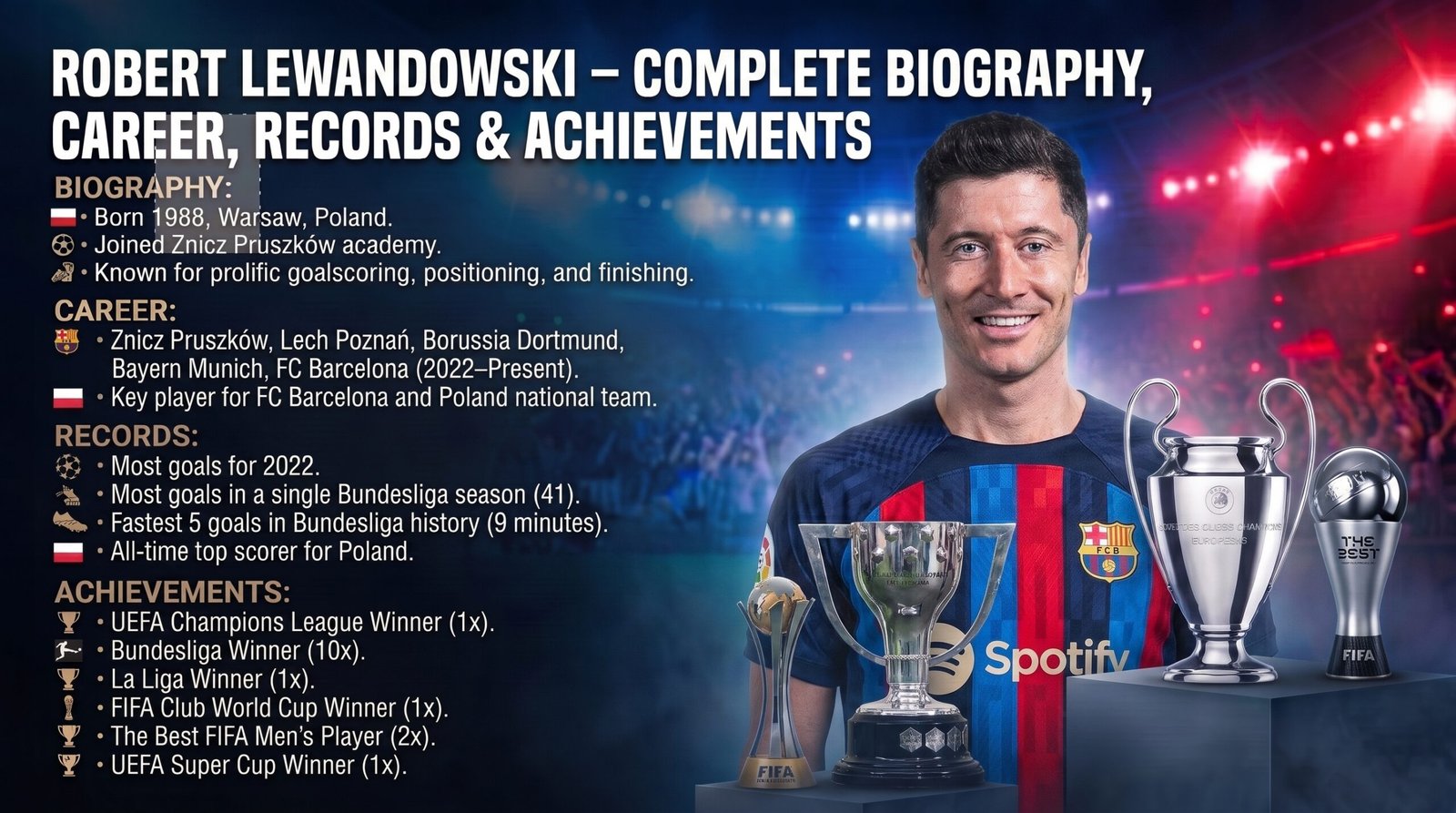
Introduction
Averaging staggering goal-scoring numbers year after year, he is part of an exclusive pantheon of players who have surpassed 700 senior career goals. From his early days in the Polish lower divisions to domestic dominance with Lech Poznań, and onto global superstardom in the German Bundesliga with Borussia Dortmund and Bayern Munich, his name became synonymous with ruthlessness in the penalty area. His subsequent high-profile move to FC Barcelona further cemented his legacy as a generational talent who could conquer any league, before he embarked on a new chapter with Major League Soccer club Chicago Fire in 2026.
Beyond his club success, Lewandowski is the ultimate symbol of Polish football. As the all-time top scorer and appearance leader for the Poland national team, he has carried the hopes of his nation on his shoulders through numerous UEFA European Championships and FIFA World Cups. This comprehensive biography delves into every facet of Robert Lewandowski’s life—his early struggles, his rise to global prominence, his meticulous fitness regime, his business acumen, and the indelible mark he has left on the beautiful game.
Early Life and Childhood
Robert Lewandowski was born on August 21, 1988, in the Polish capital of Warsaw. He grew up in the nearby town of Leszno, a modest community where opportunities for aspiring professional athletes were severely limited in the immediate post-communist era. As a child, Robert was remarkably small and skinny, leading his first coaches to affectionately nickname him “Bobek” (little beaver). Despite his slight frame, he possessed a ferocious appetite for sports, spending countless hours running, playing, and competing with older, more physically developed children.
In his formative years, football was not his only athletic pursuit. He tried his hand at volleyball, judo, and cross-country running, activities that would later contribute to his extraordinary balance, agility, and stamina on the football pitch. However, it was the ball at his feet that captured his heart. With limited infrastructure available, Robert often trained on uneven, dirt-covered local pitches. His parents recognized his burning passion early on and made significant sacrifices, often driving him for hours across the region to ensure he could attend training sessions with more organized youth teams.
This period of his life instilled a profound work ethic in the young boy. Unfazed by his physical disadvantages at the time, Lewandowski learned to rely on his intelligence, positioning, and technique rather than sheer strength. These early lessons in perseverance laid the foundation for the resilient mentality that would define his professional career.
Family Background
Athleticism is woven deeply into the fabric of the Lewandowski family. Robert was born to Krzysztof and Iwona Lewandowski, both of whom were highly accomplished athletes in their own right. His father, Krzysztof, was a national judo champion and also played professional football in the Polish second division for Hutnik Warsaw. His mother, Iwona, was an elite volleyball player for AZS Warszawa and later served as vice-president of local football club Partyzant Leszno.
This environment cultivated a disciplined, sports-centric household. Robert’s sister, Milena, also inherited the family’s athletic genes, playing volleyball at a high level and representing the Polish U21 national team. From a very young age, Krzysztof and Iwona taught Robert the importance of nutrition, rest, and dedicated practice—elements that would eventually become the pillars of his unprecedented longevity in football.
Tragically, Robert suffered a devastating loss when his father passed away in 2005. Robert was just 16 years old at the time. Krzysztof had been his biggest supporter, driving him to training and documenting his early matches. The sudden loss of his father forced Robert to mature rapidly, instilling in him a fierce determination to fulfill the athletic potential that his father had always seen in him. To this day, Lewandowski often points to the sky after scoring a goal, dedicating his achievements to the memory of the man who first taught him how to kick a ball.
Growing Up in Warsaw, Poland
Growing up in the Warsaw metropolitan area during the 1990s meant navigating a transitional period in Poland’s history. Following the fall of the Iron Curtain, the country was undergoing massive socio-economic changes, and state funding for grassroots sports was practically nonexistent. The pitches were often barren, the equipment was worn, and the winters were bitterly cold. Yet, for a young Lewandowski, these conditions were simply a part of the game.
The daily commute from Leszno to Warsaw for football practice was a grueling routine. It required early mornings, long bus rides, and late nights balancing schoolwork with athletic commitments. The harsh reality of Polish youth football weeded out those who lacked true passion, but for Robert, it only hardened his resolve. He frequently played against much larger and stronger boys, learning to protect the ball and outthink his opponents since he could not outmuscle them.
His deep connection to Warsaw remains strong. Despite traveling the globe and living in glamorous European cities, Lewandowski is immensely proud of his Polish heritage. The resilience required to succeed in his youth has translated into a mental toughness that has allowed him to thrive in the high-pressure cauldrons of the UEFA Champions League and World Cup tournaments.
Youth Career
Lewandowski’s formalized football journey began at Partyzant Leszno, a small local club where he took his first competitive steps. His obvious talent soon prompted a move to MKS Varsovia Warsaw in 1997, where he spent seven crucial developmental years. At Varsovia, he honed his fundamental skills on sand-covered fields, consistently standing out as the team’s most prolific scorer despite his slight physical stature.
In 2004, seeking a clearer path to professional football, he transferred to Delta Warsaw, a fourth-tier club where he finally began to earn a small stipend for playing. His performances for Delta caught the eye of Legia Warsaw, Poland’s most prestigious and successful club. Moving to Legia’s reserve team in 2005 seemed like a dream come true for the young forward, offering a direct route to the top flight of Polish football.
However, disaster struck when Lewandowski suffered a severe muscle injury. Believing he would not recover his pre-injury form and concerned about his lack of physical bulk, Legia Warsaw’s management unceremoniously released him in 2006. The rejection was a crushing blow. Left without a club and recovering from an injury just a year after his father’s death, many young players would have walked away from the sport. Instead, aided by his mother’s unwavering support, Robert used the rejection as the ultimate motivation to prove his doubters wrong.
Professional Debut
Following the heartbreaking release from Legia Warsaw, Lewandowski was offered a lifeline by Znicz Pruszków, a club competing in the third tier of Polish football (II liga). They signed him in the summer of 2006 for a meager fee of just 5,000 PLN (roughly €1,200). It was here that Lewandowski officially launched his professional senior career, completely determined to rebuild his trajectory.
His debut for Znicz Pruszków was a revelation. Free from the immense pressure of Legia and surrounded by a supportive coaching staff that believed in his abilities, Lewandowski began to physically mature. He hit the gym, added crucial muscle mass, and combined it with his natural finishing ability. The transformation was swift and lethal. In his first full professional season, he was unplayable, turning the Polish third division into his personal showcase and announcing his arrival to the broader footballing community.
Career at Znicz Pruszków
Lewandowski’s tenure at Znicz Pruszków (2006–2008) is widely regarded as the crucial springboard of his career. In the 2006–07 season, he led the team’s attack with devastating efficiency, finishing as the league’s top scorer with 15 goals and securing Znicz’s promotion to the Polish second division (I liga).
The step up in competition the following year did nothing to slow his momentum. In the 2007–08 season, Lewandowski once again proved his supreme goalscoring prowess. He finished as the top scorer of the second division with 21 goals in 32 appearances. His performances were characterized by a newfound physical dominance; he was no longer the fragile teenager Legia had discarded. He could hold off defenders, win aerial duels, and finish flawlessly with both feet.
Inevitably, top-tier Polish clubs came calling. Interestingly, Legia Warsaw had the opportunity to re-sign him but famously passed, with their sporting director reportedly stating they had signed a Spanish striker instead and had no need for Lewandowski. This historic misjudgment allowed another Polish giant to step in and secure the services of the hottest prospect in the country.
Lech Poznań Success
In June 2008, Lech Poznań secured Lewandowski’s signature for 1.5 million PLN (around €380,000). The move to the Ekstraklasa (the top tier of Polish football) was a significant test, but Lewandowski adapted instantly. He made his debut in July 2008 in a UEFA Cup qualifier, marking the occasion by scoring the only goal of the match. Just a month later, he made his domestic top-flight debut and scored a sensational backheel goal.
During his first season (2008–09), he finished as the league’s second-highest scorer with 14 goals, helping Lech Poznań win the Polish Cup. His sophomore season in 2009–10 was his magnum opus in Polish football. He claimed the Ekstraklasa top scorer award with 18 goals, driving Lech Poznań to their first league championship since 1993.
His phenomenal form attracted attention from major European clubs. In one of football’s most famous “what if” stories, Lewandowski was on the verge of signing for English Premier League side Blackburn Rovers in early 2010. Manager Sam Allardyce was highly impressed and a flight to the UK was booked. However, the eruption of the Icelandic volcano Eyjafjallajökull grounded all flights across Europe. The trip was canceled, and the transfer collapsed. Shortly thereafter, a German club swooped in, forever changing the trajectory of modern football history.
Borussia Dortmund Career
In the summer of 2010, Borussia Dortmund signed Lewandowski for a reported fee of €4.5 million. Under the tutelage of charismatic manager Jürgen Klopp, Lewandowski’s transition to the Bundesliga was initially challenging. He spent much of his first season playing as a substitute or deployed in an unfamiliar number 10 role behind the main striker, Lucas Barrios. Despite the adjustment period, he contributed 8 league goals as Dortmund claimed the 2010–11 Bundesliga title.
The 2011–12 season saw an injury to Barrios, opening the door for Lewandowski to lead the line. He seized the opportunity with both hands, scoring 22 league goals and adding another Bundesliga title to his collection. He cemented his hero status in the DFB-Pokal Final against fierce rivals Bayern Munich, where he scored an astonishing hat-trick in a 5–2 victory to secure a historic domestic double for Dortmund.
Lewandowski’s pinnacle at Dortmund arrived during the 2012–13 UEFA Champions League campaign. In the semi-final first leg against Real Madrid, he delivered a legendary performance, becoming the first player ever to score four goals in a Champions League semi-final. His masterclass in a 4–1 victory stunned the football world and propelled Dortmund to the final at Wembley Stadium, which they narrowly lost to Bayern Munich. After one final highly productive season where he won the Bundesliga top scorer award, Lewandowski announced he would leave Dortmund upon the expiration of his contract in 2014.
Bayern Munich Era
Moving to Bayern Munich on a free transfer in July 2014 remains one of the most astute pieces of business in football history. At Bayern, Lewandowski transitioned from a world-class striker to an undisputed footballing legend. Over eight remarkable seasons, he won the Bundesliga title every single year, systematically dismantling domestic and European defenses under managers like Pep Guardiola, Carlo Ancelotti, Jupp Heynckes, and Hansi Flick.
One of his most iconic moments occurred on September 22, 2015, against VfL Wolfsburg. Coming on as a halftime substitute with Bayern trailing 1-0, Lewandowski unleashed an unprecedented barrage, scoring 5 goals in an astonishing 8 minutes and 59 seconds. This feat shattered multiple Guinness World Records and solidified his reputation as a ruthless finisher capable of solitary destruction.
His apex arrived in the 2019–20 season, where he spearheaded Bayern’s historic treble win (Bundesliga, DFB-Pokal, and UEFA Champions League). He finished as the top scorer in all three competitions, amassing a staggering 55 goals in 47 matches. He was universally recognized as the best player in the world that year, tragically missing out on the Ballon d’Or only because the award was canceled due to the global pandemic.
The following season (2020–21), Lewandowski achieved the seemingly impossible by breaking Gerd Müller’s 49-year-old record for the most goals in a single Bundesliga campaign. He scored 41 league goals in just 29 appearances, clinching the record in the 90th minute of the final matchday. By the time he departed Bayern in the summer of 2022, he had amassed 344 goals in 375 appearances, establishing himself as the club’s second all-time top scorer behind only Müller.
Transfer to Barcelona
Seeking a new challenge in the twilight of his prime, Robert Lewandowski pushed for a transfer to Spanish giants FC Barcelona in the summer of 2022. Despite initial resistance from Bayern Munich, a deal worth a reported €45 million (plus €5 million in add-ons) was finalized in July. His arrival at Camp Nou was heralded as a massive statement of intent by Barcelona, who were in the midst of a rebuilding phase under manager Xavi Hernández.
Lewandowski immediately injected a winning mentality and elite goal-scoring reliability into the squad. Adapting seamlessly to the technical demands of La Liga, he became the focal point of Barcelona’s attack. His presence not only guaranteed goals but also served as a vital mentorship figure for the club’s emerging generation of young talents, including Pedri, Gavi, and later Lamine Yamal.
His time in Catalonia restored Barcelona to the pinnacle of Spanish football. Over his four-year tenure, Lewandowski established a profound connection with the Barcelona faithful, embracing the city’s culture and bringing immense joy back to Camp Nou. He departed the club in the summer of 2026, leaving behind a legacy of professionalism, pivotal goals, and multiple major trophies before setting off for a new adventure with the Chicago Fire in Major League Soccer.
La Liga Achievements
Lewandowski’s impact on Spanish football was immediate and devastating. In his debut 2022–23 season, he scored 23 league goals, winning the prestigious Pichichi Trophy as La Liga’s top scorer and firing Barcelona to their first league championship since 2019. His goals were clinical, often deciding tight, closely-contested matches that proved essential for the title run.
Throughout his time in Spain (2022–2026), he maintained incredible consistency. Barcelona claimed three La Liga titles during his tenure (2022–23, 2024–25, 2025–26), asserting dominance over rivals Real Madrid. He also led the team to success in domestic cup competitions, including a Copa del Rey triumph in the 2024–25 season and multiple Supercopa de España victories.
Even in his final season (2025–26) at the age of 37, Lewandowski remained an elite marksman. He tallied 14 goals in La Liga, showcasing an incredibly efficient shot-conversion rate and a continued mastery of penalty-box positioning. By the conclusion of his Barcelona career, he had registered 116 goals in 190 official matches, an extraordinary return that placed him among the best modern forwards to ever grace the Spanish top flight.
UEFA Champions League Success
The UEFA Champions League has been the grandest stage for Robert Lewandowski’s brilliance. With over 100 career goals in the competition, he sits comfortably as the third-highest goalscorer in the tournament’s illustrious history, trailing only Cristiano Ronaldo and Lionel Messi. His consistency in Europe’s premier club competition is virtually unmatched, having scored heavily for Borussia Dortmund, Bayern Munich, and FC Barcelona.
His crowning European achievement came with Bayern Munich in 2020, where his 15 goals in a single campaign drove the Bavarians to lift the trophy in Lisbon. He scored in nine consecutive Champions League matches during that run, an indicator of his sheer inevitability. His 4-goal haul against Real Madrid for Dortmund in 2013 and a rapid-fire 4-goal performance against Red Star Belgrade for Bayern highlight his ability to dismantle teams single-handedly on European nights.
During his stint at Barcelona, Lewandowski continued to add to his Champions League tally, including a solid return of 4 goals during the 2025–26 European campaign. His intelligence, ability to hold up the ball, and lethal finishing inside the box made him a nightmare for Europe’s elite center-backs for well over a decade.
Poland National Team Career
To understand Robert Lewandowski is to understand his immense dedication to the Poland national team. Making his senior debut in September 2008 against San Marino, he made an instant impact by scoring just minutes after coming on as a substitute. From that moment, he became the undisputed talisman of Polish football.
As of June 2026, Lewandowski has amassed a staggering 167 international caps and scored 89 goals, making him both the most capped player and the all-time leading goalscorer in the history of the Polish national team. He assumed the captaincy in 2014, a role he has executed with immense pride and leadership. Through periods of tactical instability and rotating managerial setups, Lewandowski has been the one constant source of world-class quality for the White and Reds.
His commitment to his country is absolute. In late 2025, after a grueling schedule, he briefly announced his retirement from international football, only to reverse the decision weeks later out of a profound sense of duty to his nation. He returned to lead the squad in their 2026 international friendlies, continuing to don the captain’s armband and mentor the next generation of Polish forwards.
International Tournaments
Lewandowski’s relationship with major international tournaments has been a mix of historic highs and heavy burdens, largely due to the varying overall strength of the Polish squads he has led. His major tournament debut came at Euro 2012, jointly hosted by Poland and Ukraine. The weight of the host nation was entirely upon him, and he delivered a spectacular opening goal in the tournament’s first match against Greece, sparking wild celebrations in Warsaw, though Poland ultimately exited in the group stage.
Euro 2016 in France represented his most successful international campaign on a team level. As a focal point that attracted multiple defenders, he opened up space for his teammates, helping Poland reach the quarter-finals before losing on penalties to eventual winners Portugal. At Euro 2020 (played in 2021), Lewandowski was individually sensational, scoring three of Poland’s four total goals in the tournament, including a magnificent brace against Sweden, though it wasn’t enough to secure knockout qualification.
His experiences at the FIFA World Cup were initially frustrating, failing to score in the 2018 edition in Russia. However, he exorcised those demons at the 2022 World Cup in Qatar. He scored his first-ever World Cup goal against Saudi Arabia, a moment that saw the usually stoic striker reduced to tears on the pitch, entirely overwhelmed by emotion. He followed it up with a penalty goal against defending champions France in the Round of 16. Through Euro 2024 and beyond, Lewandowski’s presence at international tournaments has ensured that Poland commands respect on the global stage.
Playing Style
Robert Lewandowski is widely celebrated as the archetypal modern striker, a perfect amalgamation of traditional number nine physical traits and contemporary technical proficiency. Unlike target men who rely solely on size, or poachers who only exist inside the six-yard box, Lewandowski’s game is incredibly well-rounded. He is exceptionally comfortable dropping deep into midfield to link up play, acting as a false nine to drag center-backs out of position.
His back-to-goal play is practically flawless. Possessing immaculate close control and upper body strength, he can receive the ball under immense pressure, hold off defenders, and orchestrate attacking transitions. Once the ball is shifted out wide, his movement inside the penalty area becomes predatory. He uses subtle body feints, sudden bursts of acceleration, and blind-side runs to exploit the smallest gaps in defensive lines.
Crucially, Lewandowski does not require multiple touches to be effective. A vast majority of his goals come from instinctive, first-time finishes. Whether it is a towering header, a delicate chip, or a thunderous volley, his technique remains impeccably clean regardless of the pressure or the angle.
Strengths and Skills
The foremost strength of Robert Lewandowski is his finishing ability, characterized by remarkable ambidexterity. While naturally right-footed, he has scored a staggering number of goals with his left foot, making him highly unpredictable for goalkeepers. His heading ability is equally elite; he possesses a tremendous leap and precise timing, generating immense power using his neck muscles even from standing positions.
Another monumental strength is his penalty-taking technique. Lewandowski utilizes a unique stutter-step run-up, keeping his eyes fixed entirely on the goalkeeper’s movements until the very last microsecond. This technique results in a historically high conversion rate from the spot. Furthermore, he is an underrated free-kick taker, having scored numerous direct set-pieces over his career by applying intense top-spin that dips viciously over the wall.
Defensively, his work rate is heavily praised by coaches. Especially under the high-pressing systems of Jürgen Klopp and Hansi Flick, Lewandowski was often the crucial first line of defense, utilizing intelligent pressing triggers to force opposition turnovers high up the pitch. It is this combination of lethal offensive output and disciplined defensive contribution that separates him from standard goal-poachers.
Training, Fitness, and Diet
Lewandowski’s unprecedented longevity and near-invulnerability to severe injuries are no accident; they are the result of a meticulously structured lifestyle. His physical transformation from the slender “Bobek” to a chiseled, elite athlete earned him the nickname “The Body” at Bayern Munich. His training regime extends far beyond team sessions, encompassing personalized strength and conditioning workouts tailored to maintain fast-twitch muscle fibers as he aged.
His diet, heavily influenced and curated by his wife, Anna Lewandowska (a former karate champion and renowned sports nutritionist), is legendary in football circles. They strictly avoid lactose, wheat flour, refined sugars, and fried foods. Lewandowski consumes high-quality proteins like tuna, and heavily relies on millet, oat flakes, and specific vegetable types tailored to his match-day requirements.
Perhaps the most famous aspect of his diet is his “backward eating” habit. Lewandowski often eats his meals in reverse order—starting with dessert (usually a raw cacao brownie), followed by a main course of meat or fish, and finishing with a soup or salad. This unusual method is designed to optimize digestion and blood sugar levels, ensuring maximum energy availability during the demanding 90 minutes of elite football.
Business Ventures and Sponsorships
Off the pitch, Lewandowski is a highly astute businessman who has systematically built the “RL9” global brand. Recognizing the short lifespan of an athletic career, he has diversified his portfolio significantly. He has launched his own brand of sports drinks and isotonic beverages, heavily marketed across Eastern and Central Europe, alongside an RL9 clothing line.
He is a prominent figure in the marketing world, having held long-standing sponsorships with global giants like Nike, serving as one of the primary faces for their elite football boot silos. In 2022, he famously severed ties with Chinese tech firm Huawei following the geopolitical events in Eastern Europe, demonstrating a willingness to prioritize ethical stances over lucrative contracts. Subsequently, he has worked with brands like Spotify (closely tied to Barcelona) and Gillette.
Beyond endorsements, Lewandowski has invested heavily in Polish real estate, including luxury apartments in Warsaw and a clinic specialized in sports medicine. He has also ventured into the gaming industry, investing in an independent video game development studio, proving his keen eye for modern digital markets.
Charity and Community Work
Despite his massive wealth and global fame, Lewandowski remains deeply connected to philanthropic causes. Alongside his wife Anna, he has been a consistent benefactor for the Children’s Memorial Health Institute in Warsaw, funding medical equipment and visiting young patients to raise their spirits.
Since 2014, Lewandowski has served as a Goodwill Ambassador for UNICEF, utilizing his platform to advocate for children’s rights globally and participating in campaigns focused on education, health, and disaster relief. During the global health crisis in 2020, Robert and Anna made headlines by donating €1 million to assist hospitals in their fight against the pandemic, demonstrating remarkable generosity.
Furthermore, following the outbreak of war in neighboring Ukraine in 2022, Lewandowski was one of the first and most vocal athletes to show solidarity. He famously wore a captain’s armband featuring the Ukrainian flag colors while playing for Bayern Munich, and utilized his influence to push for the Polish national team’s boycott of matches against Russia, a stance that ultimately influenced global sporting bodies.
Personal Life
Robert Lewandowski is married to Anna Lewandowska (née Stachurska). The couple met in 2007 at a sports seminar in Masuria, Poland, when Robert was still a relatively unknown player in the lower divisions. They married in June 2013 in Serock, Poland. Anna’s background in elite sports—having won multiple medals at World and European Karate Championships—made her the perfect partner to understand the immense pressures and physical demands of Robert’s career.
The couple has two daughters: Klara, born in May 2017, and Laura, born in May 2020. Despite being one of the most recognizable couples in Poland—often dubbed the “Polish Posh and Becks”—they strive to maintain a degree of privacy regarding their children’s upbringing, rarely exposing their faces on public platforms.
Away from the intense spotlight of football, Robert is known to be a quiet, grounded individual. He enjoys spending time in his luxurious villa in Majorca, Spain, and his rural retreat in the Polish lake district, where he occasionally indulges in water sports. His personal life is characterized by stability, which he frequently cites as the bedrock of his professional consistency.
Social Media Influence
As his career skyrocketed, so did his digital footprint. Robert Lewandowski commands an immense following across all major social media platforms. On Instagram, he boasts tens of millions of followers, utilizing the platform to share training routines, match celebrations, brand endorsements, and glimpses of his family life. His posts are highly curated, reflecting the premium, professional nature of his RL9 brand.
Interestingly, Lewandowski found a highly engaged, younger demographic on TikTok. During the 2020 lockdown, he began posting lighthearted dance routines, fitness challenges, and comedic skits, often featuring his wife Anna. This showcased a more relaxed, playful side of the usually intense striker, endearing him to a global Gen Z audience and vastly expanding his marketability beyond traditional football fans.
Career Statistics
The following table outlines Robert Lewandowski’s breathtaking club career statistics up until his transition to Chicago Fire in the summer of 2026. The sheer volume of matches and goals underscores his status as one of the greatest goalscorers in history.
| Club | League / Division | Tenure | Official Matches | Goals |
|---|---|---|---|---|
| Znicz Pruszków | II Liga / I Liga | 2006–2008 | 63 | 37 |
| Lech Poznań | Ekstraklasa | 2008–2010 | 82 | 41 |
| Borussia Dortmund | Bundesliga | 2010–2014 | 187 | 103 |
| Bayern Munich | Bundesliga | 2014–2022 | 375 | 344 |
| FC Barcelona | La Liga | 2022–2026 | 190 | 116 |
| Chicago Fire | Major League Soccer | 2026–Present | 0 | 0 |
| Poland National Team | International | 2008–Present | 167 | 89 |
Records
Lewandowski’s name is etched into the record books of multiple leagues and international competitions. His penchant for breaking seemingly unbreakable records has defined his legacy.
- Most goals in a single Bundesliga season: Scored 41 goals in the 2020–21 season, breaking Gerd Müller’s 49-year-old record.
- Guinness World Records: Holds four distinct records for his 5 goals in 9 minutes against Wolfsburg (fastest hat-trick, fastest 4 goals, fastest 5 goals, most goals by a substitute).
- Poland’s All-Time Top Scorer: 89 international goals.
- Poland’s Most Capped Player: 167 appearances.
- European Golden Shoe: Won back-to-back in 2020–21 (41 goals) and 2021–22 (35 goals).
- Champions League elite: Third all-time top goalscorer in the UEFA Champions League, surpassing 100 goals.
- Fastest Champions League poker: Scored 4 goals in 14 minutes against Red Star Belgrade (2019).
- Pichichi Trophy: Won the La Liga top scorer award in his debut season (2022–23).
Awards and Honors
Throughout his career, Lewandowski has accumulated an astonishing array of individual and team honors, establishing himself as the undisputed best player in the world during his peak.
| Award / Trophy | Frequency | Notable Years |
|---|---|---|
| The Best FIFA Men’s Player | 2x | 2020, 2021 |
| UEFA Men’s Player of the Year | 1x | 2019–20 |
| Ballon d’Or Striker of the Year | 2x | 2021, 2022 (Gerd Müller Trophy) |
| Bundesliga Title | 10x | 2010–11, 2011–12 (Dortmund), 2014–22 (Bayern) |
| La Liga Title | 3x | 2022–23, 2024–25, 2025–26 |
| UEFA Champions League | 1x | 2019–20 |
| Polish Footballer of the Year | 12x | 2011–2017, 2019–2023 |
| Bundesliga Top Scorer (Torjägerkanone) | 7x | Various (Joint-record holder) |
Memorable Matches
A player of Lewandowski’s caliber inevitably produces performances that pass into footballing folklore. The defining match of his early global rise occurred in April 2013, when Borussia Dortmund faced Jose Mourinho’s Real Madrid in the Champions League semi-final. Lewandowski physically bullied Pepe and Sergio Ramos, scoring all four goals in a 4-1 thrashing. His third goal, a sublime drag-back and explosive finish into the roof of the net, remains an iconic Champions League moment.
The “Wolfsburg Game” in September 2015 is perhaps his most famous. Substituted on at halftime with Bayern losing 1-0, Lewandowski scored in the 51st, 52nd, 55th, 57th, and 60th minutes. Pep Guardiola’s reaction on the touchline—clutching his bald head in sheer disbelief—perfectly encapsulated the absurdity of the achievement.
Another unforgettable night was the 8-2 demolition of FC Barcelona in the 2020 Champions League quarter-finals. While Bayern’s performance was a collective masterclass, Lewandowski was at the heart of the destruction, scoring once and providing a sublime assist, confirming his status as the apex predator of European football that season.
Greatest Goals
While known for his sheer volume of tap-ins and clinical strikes, Lewandowski’s highlight reel contains truly breathtaking goals. His fifth goal against Wolfsburg in 2015 was a spectacular acrobatic scissor-kick from the edge of the penalty area, struck with vicious power that left the goalkeeper rooted to the spot.
In 2021, against Dynamo Kyiv in the Champions League, he scored a stunning bicycle kick amid heavy snowfall in Ukraine. Adjusting his body instantly to a deflected cross, his overhead strike was a masterpiece of athleticism and spatial awareness.
His backheel goal for Lech Poznań in his Ekstraklasa debut, his spinning volley against Eintracht Frankfurt for Bayern, and a soaring header against Elche for Barcelona all demonstrate the incredible variety in his finishing arsenal. He is not just a scorer of great goals, but a great scorer of every type of goal imaginable.
Leadership and Captaincy
As the captain of the Polish national team, Lewandowski bears a tremendous psychological load. He leads by absolute example. While not the most vociferous shouter on the pitch, his leadership is derived from his relentless work rate and the impossibly high standards he demands of himself and his teammates. He expects complete professionalism in training, nutrition, and match preparation.
At Barcelona, this leadership quality became essential. Arriving as a seasoned veteran in a squad filled with exceptionally talented teenagers, Lewandowski embraced the mentor role. Young stars like Gavi and Lamine Yamal frequently cited his advice on diet, game management, and mental resilience as crucial to their development. His presence commanded instant respect in the dressing room, helping forge a winning culture during his tenure in Spain.
Legacy
“He is the most professional player I have ever met. In his head, he thinks about the right food, sleep, and training: 24 hours a day. He is always there, never injured, because he focuses on these things. He always knows what is important to be in the best condition.”
— Pep Guardiola on Robert Lewandowski
Robert Lewandowski’s legacy is firmly cemented alongside the greatest center-forwards in the history of the sport—standing shoulder-to-shoulder with the likes of Marco van Basten, Gerd Müller, Luis Suárez, and Karim Benzema. He proved that traditional striker play could be evolved to meet the high-pressing, technically demanding nature of modern football.
His story—from being released by Legia Warsaw as an injured teenager to becoming the best player in the world—is a masterclass in psychological resilience. He dominated the Bundesliga to a degree rarely seen, conquered Spain, and broke records that were deemed untouchable. Above all, Lewandowski’s legacy will be defined by his relentless, almost mechanical obsession with self-improvement, proving that with enough dedication, even a skinny kid from Warsaw can conquer the footballing world.
20 Interesting Facts
- Lewandowski’s parents gave him the name “Robert” so it would be easily recognizable globally when he became a famous athlete.
- He narrowly missed joining English club Blackburn Rovers in 2010 due to the Eyjafjallajökull volcano eruption disrupting air travel.
- His wife, Anna, won a bronze medal at the 2009 Karate World Cup.
- Lewandowski holds a Bachelor’s degree in Physical Education, having defended his thesis based entirely on his own career.
- He was the first Polish player to ever win the prestigious European Golden Shoe.
- His childhood football idol was Italian legend Alessandro Del Piero, followed by Thierry Henry.
- He is an avid fan of motorsport and regularly attends Formula 1 races during his time off.
- Lewandowski strictly eats his dessert before his main course to aid his digestion.
- During his youth career, he was so small he was nicknamed “Bobek” (little beaver).
- He speaks fluent Polish, German, English, and Spanish.
- He famously scored 5 goals in 8 minutes and 59 seconds, the fastest in top-flight European football history.
- Lewandowski has scored against every single team currently competing in the Bundesliga.
- He once bought a luxurious €7 million apartment in Warsaw equipped with a state-of-the-art golf simulator.
- He is the only player alongside Johan Cruyff to win the treble while being the top scorer in all three competitions.
- His father, a judo champion, tragically passed away when Robert was just 16.
- He was awarded the Commander’s Cross of the Order of Polonia Restituta in 2021 by the Polish President.
- Lewandowski has his own brand of coffee, aptly named “RL9 Coffee”.
- He loves playing paddle tennis in his free time to maintain his agility.
- He made a brief cameo as a voice actor in the Polish dub of a popular animated children’s movie.
- At the age of 37 in 2026, he embarked on a new journey in the United States, signing with the Chicago Fire.