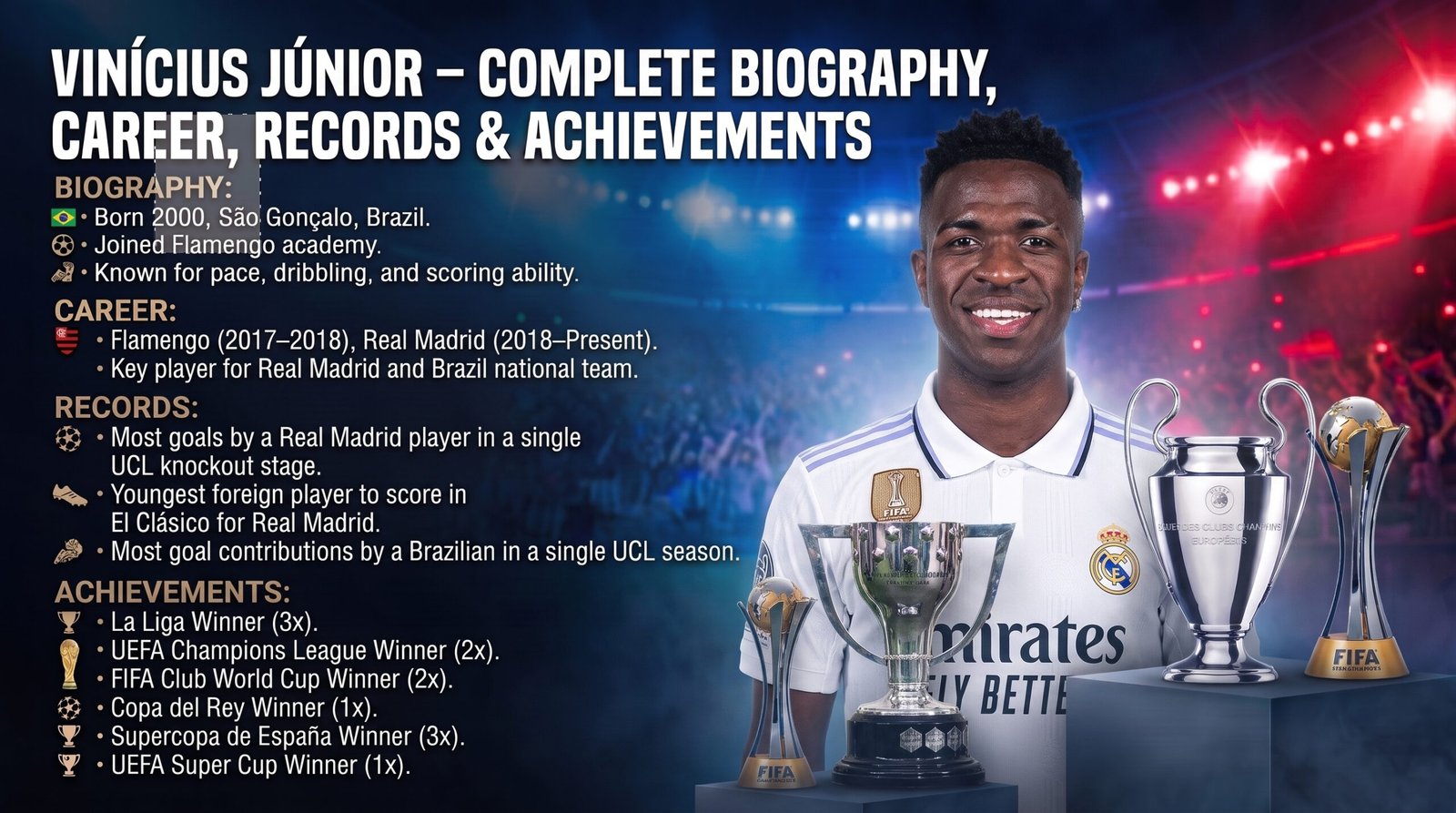
The modern footballing landscape is illuminated by a select few individuals whose mere presence on the pitch guarantees electricity, anticipation, and pure spectacle. Among this elite pantheon of global superstars, Vinícius José Paixão de Oliveira Júnior, universally known as Vinícius Júnior or simply Vini Jr., stands as a defining figure of his generation. Operating predominantly as a left-winger for Real Madrid and the Brazil national team, he has shattered the paradigm of modern tactical rigidity by reintroducing the chaotic, joyful, and devastatingly effective essence of the Brazilian “Jogo Bonito” to the highest echelons of European football. His journey from the impoverished streets of the Rio de Janeiro metropolitan area to the blinding lights of the Santiago Bernabéu is a testament to extraordinary natural talent, unyielding psychological resilience, and a relentless work ethic that has seen him evolve from a raw, inconsistent teenager into a Ballon d’Or contender and a multiple-time UEFA Champions League winner.
To understand the magnitude of Vinícius Júnior’s impact, one must look beyond his extraordinary statistics and a trophy cabinet overflowing with domestic and international honors. He represents a cultural phenomenon. In an era where data analytics and systematic pressing often stifle individual flair, Vinícius is a rebellion of rhythm and improvisation. His explosive pace, mesmeric dribbling ability, and vastly improved clinical finishing have made him arguably the most feared attacking player in world football. Furthermore, his career is deeply intertwined with his courageous, highly publicized stand against racism in Spanish football, elevating him from a mere sports entertainer to a prominent civil rights advocate for the modern era. This comprehensive biography meticulously chronicles every facet of his life, exploring his humble beginnings, his meteoric rise, his tactical evolution, and the profound legacy he is actively building both on and off the pitch.
Early Life and Childhood
Vinícius José Paixão de Oliveira Júnior was born on July 12, 2000, in the sprawling, densely populated municipality of São Gonçalo, located across the Guanabara Bay from the city of Rio de Janeiro, Brazil. Born into severe economic hardship, his early life was characterized by the stark realities of urban poverty that affect millions of working-class Brazilian families. The neighborhood of Mutuá, where he spent his earliest years, was a challenging environment where opportunities were scarce, and the threat of falling into the margins of society was ever-present. However, like many Brazilian youths, Vinícius found salvation, identity, and an unbridled sense of joy in the sport of football.
His affinity for the game was apparent almost from the moment he could walk. Family members recall a toddler who was inseparable from his football, treating it not just as a toy, but as a constant companion. Because grass pitches were a luxury rarely found in his immediate vicinity, Vinícius honed his earliest skills on the unforgiving concrete streets and dirt patches of his neighborhood. These informal, unstructured matches, known locally as “peladas,” were characterized by intense physical contact, tight spaces, and a heavy emphasis on individual trickery and improvisation just to survive against older, stronger boys. It was in this raw, uncoached crucible that the foundational elements of Vinícius Júnior’s playing style—his fearless dribbling, his low center of gravity, and his ability to manipulate the ball in microscopic spaces—were forged.
Recognizing his prodigious talent early on, his family sought structured avenues for his development. Before transitioning to traditional association football, Vinícius, like legendary Brazilian predecessors Ronaldinho and Neymar, spent his formative years playing futsal. He enrolled at the Canto do Rio club in Niterói, a neighboring municipality. The fast-paced, highly technical nature of futsal, played on a small hard court with a heavier, low-bounce ball, exponentially accelerated his technical development. It demanded instantaneous decision-making, exceptional ball control under extreme pressure, and an innovative approach to beating defenders in one-on-one situations—skills that would later become the hallmarks of his professional career on the full-sized pitch.
Family Background
The trajectory of Vinícius Júnior’s career cannot be accurately documented without deeply acknowledging the profound sacrifices and unwavering support of his family. He was born to his father, Vinícius José Paixão de Oliveira, and his mother, Tatiana. His parents worked tirelessly to provide for their family in an environment where sheer survival often superseded the luxury of chasing dreams. His father, in particular, recognized his son’s generational talent and took on multiple physically demanding jobs, including working as a cable technician and a computer technician, traveling extensively to ensure there was enough money to afford the football boots, bus fares, and club fees required to keep Vinícius in the developmental system.
The logistical challenges of pursuing a footballing career in Rio de Janeiro are immense. As Vinícius advanced through the local ranks and caught the attention of Clube de Regatas do Flamengo, Brazil’s most popular football club, the geographical distance between his home in São Gonçalo and Flamengo’s training facilities, Ninho do Urubu, became a critical hurdle. The daily commute involved multiple buses and took hours, physically draining the young boy and placing a massive financial burden on his family. To alleviate this, a heart-wrenching but necessary family decision was made. Vinícius moved out of his parents’ home at a very young age to live with his uncle, Ulisses, in the neighborhood of Abolição, which was significantly closer to the Flamengo training complex.
This separation from his parents and siblings was emotionally taxing for a child barely entering his teenage years. However, it instilled in him a profound sense of responsibility and maturity. His uncle Ulisses provided not only a roof over his head but also vital emotional support and guidance during the highly competitive and often ruthless selection processes of youth academy football. Vinícius frequently credits his family’s collective sacrifice as the ultimate driving force behind his relentless work ethic. Every sprint, every dribble, and every goal in his early career was dedicated to validating the monumental leap of faith his parents and uncle took to ensure his success.
Growing Up in São Gonçalo, Brazil
São Gonçalo is a municipality that carries a complex reputation. As the second most populous city in the state of Rio de Janeiro, it boasts a vibrant culture and a deeply resilient population, but it is simultaneously plagued by severe infrastructural deficits, high levels of poverty, and significant issues with urban violence. Growing up in this environment fundamentally shaped Vinícius Júnior’s worldview and his approach to his profession. The socio-economic disparity meant that failure in his footballing pursuit was not just a sporting disappointment; it meant remaining trapped in a cycle of poverty.
The streets of São Gonçalo served as his first, and perhaps most important, academy. In Brazil, street football is an intensely cultural phenomenon. It is an egalitarian space where status is determined entirely by what one can do with a ball at their feet. Vinícius frequently played against older teenagers and adults. To avoid being physically bullied off the ball, he had to be quicker, smarter, and more inventive. He learned to use feints, body drops, and sudden bursts of acceleration—not as showboating tactics, but as vital survival mechanisms to protect the ball and progress play. The “ginga,” a rhythmic, swaying movement associated with the martial art of capoeira and deeply embedded in Brazilian footballing DNA, became second nature to him.
Furthermore, the environment instilled a profound psychological toughness. Players emerging from such impoverished backgrounds often possess an insatiable hunger and a desperate drive that cannot be replicated in sterilized European academies. The pressure of playing in front of thousands of hostile fans in a Champions League semi-final is immense, but for Vinícius, it is a vastly different, more manageable type of pressure compared to the pressure of knowing his footballing success was the sole ticket to providing a safe, comfortable life for his entire extended family. This background explains the fearless joy with which he plays; having overcome the immense socio-economic hurdles of his youth, the football pitch is a sanctuary where he is entirely free to express his immense talents.
Youth Career at Flamengo
Vinícius Júnior’s formal introduction to association football began at a very young age when he enrolled at one of the many Escolinha Fla branches—affiliated football schools of Clube de Regatas do Flamengo—located in his hometown of São Gonçalo. His precocious talent was immediately blinding. By the age of nine, he was taken to a trial for Flamengo’s futsal team. While he impressed the coaches immensely, they noted his slight physical frame and requested he return the following year. Undeterred, Vinícius opted to pivot entirely from futsal to field football, passing his trials for Flamengo’s youth academy, the base categories, in August 2010.
His ascent through the ranks of Ninho do Urubu (Flamengo’s famed academy) was nothing short of meteoric. He consistently played in age groups one or two years above his actual age, a testament to his physical resilience and vastly superior technical capabilities. As an under-15 player, he led Flamengo to the Copa Votorantim, one of the most prestigious youth tournaments in Brazil, finishing as the top scorer. His ability to isolate defenders on the left flank, commit them, and bypass them with explosive bursts of pace drew massive crowds to youth games, an anomaly in Brazilian academy football.
The turning point, where he transformed from a highly-rated local prospect into a global sensation, occurred in early 2017 during the Copa São Paulo de Futebol Júnior (commonly known as the Copinha). It is the premier under-20 tournament in Brazil, heavily scouted by European powerhouses. Despite being just 16 years old and playing against men up to four years his senior, Vinícius was the undisputed star of the tournament. His performances were electrifying, characterized by audacious skill, a high volume of successful dribbles, and a natural flair that drew immediate, overwhelming comparisons to a young Neymar. Following his dazzling displays in the Copinha, he was called up to the Brazilian Under-17 national team for the South American U-17 Championship in Chile. He utterly dominated the continental competition, finishing as the tournament’s top scorer with seven goals and being unanimously named the Best Player of the Tournament, securing Brazil the title. By this time, the secret was out; every elite club in Europe was violently competing for his signature.
Professional Debut
The incredible hype surrounding Vinícius Júnior created a clamor among the Flamengo fanbase for his immediate promotion to the senior squad. The club’s management, acutely aware of the generational asset they possessed, carefully managed his integration to protect him from the immense, suffocating pressure of the Brazilian media landscape. However, his talent could not be contained in the youth ranks any longer. On May 13, 2017, at just 16 years and 10 months of age, Vinícius made his highly anticipated professional debut for Flamengo. He came on as a late substitute for Orlando Berrío in a 1-1 draw against Atlético Mineiro in the opening match of the Campeonato Brasileiro Série A, played at the iconic Maracanã Stadium.
Merely two days after his professional debut, Flamengo, acutely aware of the circling European giants, extended his contract until 2022, inserting a massive €45 million buyout clause. This move was strategic, designed to extract maximum value in his inevitable transfer. His first few months as a professional were a steep learning curve. He was suddenly playing against seasoned professionals who recognized his reputation and routinely subjected him to harsh, physical challenges to test his mettle. Despite his slight frame, Vinícius showed remarkable resilience, rarely complaining and continuously demanding the ball.
He scored his first professional goal on August 10, 2017, in a Copa Sudamericana match against Chilean side Palestino, just seconds after coming onto the pitch as a substitute. Three days later, he scored his first goals in the Brazilian top flight, netting a crucial brace in a 2-0 victory over Atlético Goianiense. As the 2017 season progressed, he became an increasingly vital component of the Flamengo squad. He played a significant role in their run to the 2017 Copa Sudamericana final, although Flamengo ultimately fell short against Independiente of Argentina. By the end of his breakthrough season, he had demonstrated that despite his raw tactical understanding, his sheer pace and dribbling ability were already world-class weapons that could dismantle professional defensive structures.
Transfer to Real Madrid
The battle for Vinícius Júnior’s signature was one of the most fiercely contested transfer sagas of the decade. While rivals FC Barcelona had initially made significant inroads, leaning heavily on the influence of Neymar to court the young prodigy, Real Madrid’s president, Florentino Pérez, was absolutely determined not to lose out on a generational Brazilian talent, a strategic pivot made after having missed out on Neymar years earlier. On May 23, 2017, just ten days after his professional debut and before he had even turned 17, Real Madrid officially announced that they had reached an agreement to acquire Vinícius Júnior.
The financial parameters of the deal were staggering and unprecedented for a player of his age and experience. Real Madrid agreed to pay a fixed transfer fee of €46 million, making him the second most expensive player in the history of Brazilian football at the time, trailing only Neymar, and the most expensive transfer ever for a player under the age of 19. Due to strict FIFA regulations concerning the international transfer of minors, the transfer could not be officially finalized, and Vinícius could not relocate to Spain, until he turned 18 on July 12, 2018.
This massive pre-agreement created a bizarre dynamic. For an entire year, Vinícius played for Flamengo while officially being a Real Madrid player-in-waiting. Every touch, pass, and mistake he made in Brazil was scrutinized under the unforgiving microscope of the Spanish sports media. He handled this bizarre transitional period with remarkable maturity, continuing to develop his game and scoring crucial goals for Flamengo in the Copa Libertadores during the first half of 2018. Finally, upon turning 18, he officially transitioned to the Spanish capital. He was unveiled at the Santiago Bernabéu on July 20, 2018, presented to the fans by Real Madrid legend and fellow Brazilian Ronaldo Nazário, signaling the club’s immense expectations that he would be the heir to their attacking legacy.
Development at Real Madrid
The transition from South American football to the tactical rigors and immense pressure of Real Madrid is notoriously difficult, and Vinícius’s early years in Spain were characterized by extreme highs and challenging, confidence-testing lows. He initially began his European career playing for Real Madrid Castilla, the club’s reserve team in the Spanish third tier, under the management of Santiago Solari. It quickly became apparent that the third division was far below his level; he was physically targeted by opposition defenders but still managed to dominate matches with his superior technique.
His breakthrough into the first team occurred in late 2018 when Solari was promoted to manage the senior squad following the dismissal of Julen Lopetegui. Solari trusted the young Brazilian immensely, making him a focal point of the attack. Vinícius responded with electric performances, becoming the team’s primary creative outlet. His ability to progress the ball and break defensive lines was unmatched in the squad. However, his initial seasons were also defined by a glaring weakness: his finishing. He would frequently embark on mesmerizing solo runs, beating three or four defenders, only to rush his final shot or misplace the final pass. The Spanish media, historically unforgiving, heavily criticized his lack of composure in the final third, branding him as a player with all the flair but no end product.
This period tested his psychological resolve profoundly. A highly publicized incident in 2020 saw a tunnel camera capture veteran striker Karim Benzema allegedly telling a teammate in French, “Don’t play with him. On my mother’s life, he is playing against us,” referencing Vinícius’s erratic decision-making. Lesser players might have crumbled, but Vinícius absorbed the criticism, maintained a close, respectful relationship with Benzema, and doubled down on his training. The true turning point arrived with the return of manager Carlo Ancelotti in the 2021/2022 season. Ancelotti instilled a massive sense of confidence in the winger, simplifying his instructions in the final third and encouraging him to take an extra touch to compose himself before shooting. The results were immediate and explosive. Vinícius transformed from an erratic prospect into a lethal finisher, forging a telepathic partnership with Benzema and establishing himself as one of the most effective wide forwards in world football.
UEFA Champions League Success
Real Madrid’s identity is inextricably linked to the UEFA Champions League, and Vinícius Júnior has rapidly inscribed his name into the illustrious history of the competition, cementing his reputation as the ultimate big-game player. While his early Champions League appearances were characterized by flashes of brilliance, it was during the miraculous 2021/2022 campaign that he truly conquered Europe. Throughout the knockout stages, as Real Madrid navigated a gauntlet of elite opposition, Vinícius was their most devastating weapon. His blinding pace on the counter-attack dismantled Paris Saint-Germain, Chelsea, and Manchester City in consecutive, historically dramatic ties.
His crowning achievement of that campaign arrived in the final against Liverpool, held at the Stade de France in Paris on May 28, 2022. In a tense, tightly contested match where Real Madrid spent long periods absorbing immense pressure, it was Vinícius who delivered the decisive blow. In the 59th minute, he ghosted in at the back post, expertly evading the awareness of Trent Alexander-Arnold, to tap in a precise cross from Federico Valverde. That single goal secured Real Madrid’s 14th European Cup and immortalized Vinícius in the club’s folklore at just 21 years of age. He was subsequently named the inaugural UEFA Champions League Young Player of the Season, finishing the campaign with an astounding four goals and six assists in the competition.
He proved this success was not an anomaly by consistently delivering in the competition year after year. He became the nemesis of English clubs in Europe, routinely delivering masterclasses against the Premier League’s elite. His impact reached another pinnacle during the 2023/2024 season. Operating as the undisputed talisman of the squad following Karim Benzema’s departure, Vinícius led Real Madrid to their 15th Champions League title. He scored crucial goals against Bayern Munich in the semi-finals and, fittingly, sealed the victory in the final against Borussia Dortmund at Wembley Stadium. By scoring in his second Champions League final, he surpassed Lionel Messi’s record to become the youngest player in history to score in multiple Champions League finals, a staggering testament to his clutch performances on the grandest stage in club football.
La Liga Achievements
Domestically, Vinícius Júnior has been equally central to an era of sustained success for Real Madrid in the Spanish top flight. He secured his first La Liga title during the COVID-19 interrupted 2019/2020 season under Zinedine Zidane, contributing crucial energy and directness in a heavily disrupted campaign. However, it was during the 2021/2022 season that he evolved into a dominant, league-winning force. He registered 17 goals and 10 assists in La Liga that year, numbers that definitively silenced his critics and proved his capacity for sustained excellence over a grueling 38-game season.
His impact in domestic competitions is heavily defined by his performances in “El Clásico” against fierce rivals FC Barcelona. Vinícius has consistently tormented Barcelona’s defensive lines. In March 2020, he scored the opening goal in a 2-0 victory, becoming the youngest foreign goalscorer in the history of the fixture in La Liga, breaking a record previously held by Lionel Messi. In January 2024, he delivered one of the most dominant individual performances in recent Clásico history, scoring a spectacular first-half hat-trick against Barcelona in the final of the Supercopa de España in Saudi Arabia, utterly dismantling their defensive high line.
By the conclusion of the 2023/2024 season, Vinícius had amassed multiple La Liga titles, Copa del Rey victories, and Supercopa medals. He transitioned from being a promising winger to the primary focus of every domestic opponent’s tactical preparation. Teams in La Liga frequently employ double and triple-marking systems exclusively designed to neutralize his threat, often resorting to aggressive tactical fouling. Despite this intense scrutiny and physical punishment, his offensive output has only continued to scale, solidifying his status as the premier attacking player in Spanish football and the primary catalyst for Real Madrid’s domestic dominance in the 2020s.
Brazil National Team Career
Representing the Brazilian national team, the “Seleção,” carries a unique, crushing weight of expectation, demanding not just success, but aesthetic brilliance. Vinícius Júnior’s integration into the senior national team was a gradual process, managed carefully by former head coach Tite. He earned his first senior call-up in February 2019 but was forced to withdraw due to an ankle injury sustained playing for Real Madrid. He eventually made his highly anticipated senior international debut on September 10, 2019, coming on as a substitute in a 1-0 defeat against Peru in a friendly match played in Los Angeles.
During his early years with the national team, Vinícius struggled to replicate the devastating club form he was beginning to show in Madrid. The tactical setup of the Seleção, which often heavily revolved around the central playmaking of Neymar, required Vinícius to adapt his game, focusing more on holding width and making disciplined runs rather than serving as the primary chaotic outlet. He was part of the Brazilian squad that reached the final of the 2021 Copa América on home soil, though he featured primarily as a substitute throughout the tournament, ultimately watching his side lose the final 1-0 to Argentina at the Maracanã.
As his status at Real Madrid elevated him to global superstardom, his role within the national team correspondingly evolved. By the time the 2022 FIFA World Cup qualification cycle concluded, he had established himself as a definitive starter on the left wing. With Neymar adopting a deeper, central role, Vinícius became Brazil’s primary attacking thrust in transition. While he is still working towards achieving the legendary status of Brazilian icons like Ronaldo, Ronaldinho, or Neymar on the international stage, he is universally recognized as the face of the new generation of Brazilian football. He has inherited the symbolic responsibility of bringing the “hexa”—the elusive sixth World Cup title—back to a nation that demands absolute footballing perfection.
International Tournaments
Vinícius Júnior entered the 2022 FIFA World Cup in Qatar as one of the most in-form players on the planet, carrying immense expectations to propel Brazil deep into the tournament. He started the competition brilliantly, providing crucial assists in the group stage matches against Serbia and Switzerland, showcasing his ability to break down deep, organized defensive blocks. His standout moment of the tournament occurred in the Round of 16 against South Korea, where he opened the scoring with a sublimely composed, measured finish at the far post, followed by an iconic, joyous dancing celebration alongside his teammates and manager Tite. However, Brazil’s campaign ended in severe heartbreak in the quarter-finals, where they were eliminated by Croatia via a penalty shootout following a 1-1 draw after extra time. Despite the collective failure, Vinícius’s individual performances cemented his status as an elite international performer.
The 2024 Copa América, held in the United States, marked a transitional period for Brazil following the departure of Tite and a long-term injury to Neymar. The burden of leadership and offensive creation fell squarely onto Vinícius’s shoulders. He embraced this responsibility, delivering a sensational two-goal performance against Paraguay in the group stages, demonstrating his elite finishing and ability to dismantle defensive structures single-handedly. However, the weight of expectations and a disjointed team structure saw Brazil crash out in the quarter-finals against Uruguay on penalties, a match Vinícius agonizingly missed due to a suspension accumulated from yellow cards. Despite the setbacks, his trajectory indicates he will be the absolute focal point of Brazil’s attack as they build towards the 2026 FIFA World Cup.
Playing Style
Vinícius Júnior is the quintessential modern interpretation of the classic Brazilian winger. Primarily operating on the left flank as an inverted forward, he utilizes his naturally stronger right foot to cut inside, driving directly into the heart of opposition defenses to shoot or orchestrate play. Unlike traditional wingers whose sole purpose is to hug the touchline and deliver crosses, Vinícius is an aggressive inside forward who acts as a primary goalscoring threat. His playing style is an intoxicating blend of chaotic street-football flair and devastating, highly-drilled European efficiency.
Tactically, his evolution has been fascinating to observe. Under Carlo Ancelotti’s system at Real Madrid, particularly following the departure of traditional number nine Karim Benzema, Vinícius was asked to operate more centrally. In a fluid 4-4-2 diamond or a narrow 4-3-3, he frequently drifted inside, operating in the half-spaces and occasionally playing directly off the shoulder of the last defender as a central striker. This tactical flexibility makes him a nightmare to defend; full-backs struggle to contain him when he stays wide, and center-backs are often outpaced and outmaneuvered when he moves centrally. His ability to receive the ball with his back to goal, spin his marker in a single fluid motion, and instantly accelerate into space is currently unparalleled in world football.
Strengths and Skills
The most immediately apparent and terrifying attribute Vinícius possesses is his explosive, world-class pace. His acceleration from a standing start over the first five yards allows him to create immediate separation from defenders, while his top speed over long distances makes him arguably the most lethal counter-attacking player in the sport. However, pace alone does not create a superstar. What elevates him is his elite technical mastery while moving at absolute top speed. The ball appears tethered to his boots; his close control in tight, congested areas allows him to navigate out of situations where most players would simply lose possession.
His dribbling repertoire is extensive, heavily featuring the “elastico,” rapid step-overs, and devastating body feints. He does not use these skills for mere showboating; they are highly functional tools used to off-balance defenders just enough to create a shooting angle or a passing lane. Over the years, his most significant area of improvement has been his finishing. Once criticized for being erratic in front of goal, he has developed a vast array of finishes. He is highly proficient at curling the ball into the far corner with the inside of his right foot, executing powerful near-post strikes, and demonstrating remarkable composure in one-on-one situations with the goalkeeper. Furthermore, his playmaking abilities are often vastly underrated. He possesses excellent vision and is capable of delivering precise cut-backs, perfectly weighted through balls, and accurate crosses with the outside of his boot (the trivela).
Training, Fitness, and Work Ethic
The physical transformation of Vinícius Júnior from a slightly built, raw 18-year-old arriving from Brazil into a robust, elite European athlete is a testament to his monumental work ethic and absolute dedication to his craft. Recognizing that the intense physicality of La Liga and the Champions League demanded more than just natural talent, Vinícius invested heavily in his physical development. He employs a vast personal team, including specialized personal trainers, physiotherapists, a private chef, and sports psychologists, effectively running his career like a highly optimized, independent corporation.
His daily routine extends far beyond the mandatory club training sessions at Real Madrid’s Valdebebas complex. He has installed a hyperbaric oxygen chamber in his home in Madrid to exponentially accelerate muscle recovery after matches, a critical tool given the brutal 60-game seasons he frequently plays. His diet is meticulously strictly controlled, focused on lean proteins, complex carbohydrates, and absolute hydration, designed to maximize his explosive power while preventing soft-tissue injuries. This fanatical dedication to biomechanics, injury prevention, and physical maintenance is the invisible foundation upon which his dazzling on-pitch performances are built, allowing him to sustain extreme levels of high-intensity sprinting well into the 90th minute of matches.
Business Ventures and Sponsorships
As his profile on the pitch skyrocketed, Vinícius Júnior has systematically built himself into a global commercial juggernaut off it. He is highly conscious of his brand value and has aligned himself with premium global corporations. His most significant and occasionally tumultuous partnership has been with Nike. Having signed with the American sportswear giant at just 13 years old, he became one of their marquee global football athletes. While there was a highly publicized contract dispute in 2023 where he temporarily wore blacked-out boots due to a perceived lack of brand appreciation, the relationship was eventually restructured, reaffirming his status as a premier face of the company alongside athletes like Kylian Mbappé and Erling Haaland.
Beyond footwear, his commercial portfolio is expansive and lucrative. He serves as a prominent global ambassador for Pepsi, frequently starring in their high-budget international advertising campaigns. He has strong ties with EA Sports, regularly featuring heavily in the marketing for the EA FC (formerly FIFA) video game franchise. He has also partnered with luxury fashion brands, utilizing his immense social media reach to bridge the gap between high-end fashion and urban street culture. Vinícius’s management team carefully curates his sponsorships, ensuring that every partnership aligns with his dynamic, youthful, and globally appealing personal brand.
Charity and Community Work
Vinícius Júnior has never forgotten the intense poverty of his childhood in São Gonçalo, and he has channeled his immense wealth and global platform to enact profound, tangible change in Brazil. In 2021, he founded the Instituto Vini Jr. (Vini Jr. Institute), an educational charity based in Rio de Janeiro. Recognizing that the traditional Brazilian educational system often fails marginalized youth, the institute’s core mission is to utilize technology and the universal language of football to innovate the teaching process and keep children engaged in school.
The institute developed an innovative educational application called “Base” (a play on words, as “base” in Brazilian football refers to the youth academy). The app uses football-themed interfaces, terminology, and gamification to teach core subjects like mathematics, Portuguese, and science to primary school children in impoverished public schools. Vinícius personally funded the launch of the institute with millions of dollars of his own money. For his extraordinary humanitarian efforts, he was awarded the prestigious Socrates Award at the 2023 Ballon d’Or ceremony in Paris, an honor dedicated to footballers who champion outstanding social and charitable initiatives. He represents a new breed of athlete-activist, using his influence not just for charity, but to structurally reform educational opportunities in his home country.
Personal Life
Despite living his life under the blinding glare of the global media spotlight, Vinícius Júnior fiercely protects his inner circle and maintains a relatively private personal life. He remains extraordinarily close to his family, many of whom have relocated to Madrid to live with him in his luxurious residence. He frequently credits his family’s presence in Spain as the primary reason for his emotional stability and his ability to handle the immense pressure of playing for Real Madrid.
Away from the football pitch, he is a massive fan of American sports, particularly the NBA. He frequently travels to the United States during the European offseason to attend basketball games court-side, cultivating close friendships with prominent NBA superstars. He is also deeply passionate about fashion and urban streetwear, often seen attending high-profile fashion weeks in Paris and Milan. His close circle of friends, colloquially referred to by the Spanish press as his “entourage,” consists primarily of childhood friends from Brazil, ensuring he remains grounded and connected to his roots despite his extraordinary wealth and fame.
Social Media Influence
With tens of millions of followers across platforms like Instagram, X (formerly Twitter), and TikTok, Vinícius Júnior is one of the most followed and influential athletes on the planet. He utilizes his massive digital footprint expertly. On one level, it serves as a highly curated portal into his life, showcasing his fashion, his celebrations, his sponsor activations, and his relationships with other global celebrities, directly fueling his immense commercial value.
However, more significantly, he has weaponized his social media platforms to wage a high-profile, uncompromising war against racism. Following repeated, horrific instances of racial abuse directed at him by opposing fans in Spanish stadiums, Vinícius refused to remain silent. He has used his accounts to publicly call out La Liga authorities, post damning video evidence of racist behavior, and demand systemic legal changes in Spain. His digital activism has forced a global conversation regarding racism in European football, transcending sports media and forcing responses from political leaders in both Spain and Brazil. His social media is a powerful tool of both brand building and fierce social advocacy.
Career Statistics
The statistical evolution of Vinícius Júnior highlights his transition from a raw, inconsistent talent to one of the most productive forwards in world football. Since his breakout season under Carlo Ancelotti, his goal and assist numbers have firmly established him in the absolute elite tier of global attackers.
| Club | Season | League Apps | League Goals | Cup Apps | Cup Goals | Continental Apps | Continental Goals | Total Apps | Total Goals |
|---|---|---|---|---|---|---|---|---|---|
| Flamengo | 2017 | 25 | 3 | 4 | 0 | 7 | 1 | 37 | 4 |
| Flamengo | 2018 | 12 | 4 | 2 | 0 | 5 | 2 | 32 | 10 |
| Real Madrid | 2018–19 | 18 | 2 | 8 | 2 | 4 | 0 | 31 | 4 |
| Real Madrid | 2019–20 | 29 | 3 | 3 | 1 | 5 | 1 | 38 | 5 |
| Real Madrid | 2020–21 | 35 | 3 | 2 | 0 | 12 | 3 | 49 | 6 |
| Real Madrid | 2021–22 | 35 | 17 | 4 | 1 | 13 | 4 | 52 | 22 |
| Real Madrid | 2022–23 | 33 | 10 | 7 | 3 | 12 | 7 | 55 | 23 |
| Real Madrid | 2023–24 | 26 | 15 | 3 | 3 | 10 | 6 | 39 | 24 |
Records
Vinícius Júnior has broken numerous historical records, placing his name alongside some of the greatest players to ever grace the sport. His ability to perform on the biggest stages at a remarkably young age has rewritten the history books for both Real Madrid and the UEFA Champions League.
- Youngest foreign player to score for Real Madrid in an El Clásico against Barcelona in La Liga (March 2020), breaking Lionel Messi’s record.
- Youngest player in history to score in two separate UEFA Champions League Finals (2022 and 2024).
- First Brazilian player to score in multiple UEFA Champions League finals.
- Second most expensive Brazilian transfer in history at the time of his move to Real Madrid (€46 million at age 16).
- First player born in the 2000s to play a senior competitive match for Real Madrid.
- Inaugural winner of the UEFA Champions League Young Player of the Season award (2021/2022).
Awards and Honors
His trophy cabinet reflects a period of absolute dominance for Real Madrid in Europe, supplemented by vast individual recognition from the global football community.
| Category | Award / Honor | Year(s) |
|---|---|---|
| Real Madrid | UEFA Champions League | 2021–22, 2023–24 |
| Real Madrid | La Liga | 2019–20, 2021–22, 2023–24 |
| Real Madrid | FIFA Club World Cup | 2018, 2022 |
| Real Madrid | Copa del Rey | 2022–23 |
| Real Madrid | Supercopa de España | 2019–20, 2021–22, 2023–24 |
| Real Madrid | UEFA Super Cup | 2022, 2024 |
| Brazil | South American U-17 Championship | 2017 |
| Individual | UEFA Champions League Player of the Season | 2023–24 |
| Individual | Socrates Award | 2023 |
| Individual | FIFA FIFPro World11 | 2023 |
Memorable Matches
Certain matches define a player’s legacy, acting as indisputable evidence of their greatness. For Vinícius, several performances stand out as masterclasses in attacking football.
- Real Madrid 1 – 0 Liverpool (May 2022): The Champions League final in Paris. Vinícius scored the only goal of the game, cementing his name in Real Madrid history and securing the club’s 14th European Cup.
- Liverpool 2 – 5 Real Madrid (February 2023): In a brutal Champions League knockout match at Anfield, with Madrid down 2-0 early, Vinícius single-handedly dragged his team back into the tie. He scored two spectacular goals in the first half to level the game, breaking Liverpool’s spirit and sparking a historic comeback.
- Real Madrid 4 – 1 Barcelona (January 2024): In the Supercopa de España final, Vinícius delivered a devastating first-half hat-trick. His movement completely dismantled Barcelona’s high defensive line, culminating in him mimicking Cristiano Ronaldo’s iconic “Siuu” celebration in front of the fans in Saudi Arabia.
- Real Madrid 3 – 1 Manchester City (May 2022): In the chaotic Champions League semi-final second leg, while Rodrygo scored the late goals, it was Vinícius’s relentless running and a sensational dummy past Fernandinho to score a solo goal in the first leg that set the tone for the entire tie.
Greatest Goals
Vinícius’s highlight reel is a vast collection of breathtaking solo efforts, clinical finishes, and moments of pure improvisation.
- The Solo Run vs Manchester City (2022): Receiving the ball inside his own half on the left touchline, he audaciously dummied the ball through the legs of veteran midfielder Fernandinho. He then sprinted over 50 yards down the flank, entered the penalty area, and slotted a cool finish past Ederson, showcasing an unbelievable combination of intelligence, pace, and composure.
- The Match-Winner vs Sevilla (2021): In a tight La Liga encounter, he controlled a cross-field pass on his chest near the touchline. He immediately drove inside, bypassed two defenders, and unleashed a ferocious, swerving right-footed strike from 25 yards out that nestled perfectly into the top corner, winning the game in the dying minutes.
- The Champions League Final Winner (2022): While not his most aesthetically spectacular goal, it remains his most important. His spatial awareness to lose Trent Alexander-Arnold and perfectly time his run to the back post to tap in Valverde’s cross was a masterclass in elite forward movement.
Rivalries and Partnerships
On the pitch, his most notable individual rivalry has been with Barcelona’s Uruguayan center-back Ronald Araújo. Barcelona frequently deployed Araújo at right-back specifically to combat Vinícius’s pace in El Clásico. Their physical, intense, yet largely mutually respectful duels became one of the most highly anticipated tactical battles in European football. Conversely, his most devastating partnership was formed with Karim Benzema. The veteran Frenchman acted as the perfect foil, dropping deep to link play and create vast spaces in behind the defense for the Brazilian’s explosive diagonal runs. Their telepathic understanding was the foundation of Real Madrid’s 2022 Champions League triumph.
Off the pitch, however, his most significant rivalry is his ongoing battle against racism. Vinícius has repeatedly clashed with La Liga’s leadership, specifically president Javier Tebas, demanding harsher punishments for clubs whose fans engage in racist abuse. His defiance in the face of hostile stadiums across Spain—pointing out abusers to referees and refusing to be silenced by the establishment—has drawn global support from fellow athletes, politicians, and human rights organizations, elevating him into a symbol of modern civil rights in sports.
Legacy
At an age when most players are just beginning to enter their physical prime, Vinícius Júnior has already secured a legacy that guarantees his immortality in the annals of football history. At Real Madrid, a club characterized by its unforgiving demands and its history of iconic “Galácticos,” he has established himself as the undisputed talisman of a new generation. He proved that the chaotic, joyful essence of Brazilian street football can not only survive but utterly dominate the hyper-tactical environment of modern European football.
However, his ultimate legacy will likely transcend the boundaries of the sport. By courageously utilizing his platform to combat systemic racism in Spain, he has shifted the paradigm of what is expected from modern superstar athletes. He is not merely a product of the football industry; he is an active agent attempting to reform its morality. Whether he goes on to win multiple Ballon d’Or awards or lead Brazil to a World Cup victory, Vinícius Júnior will be remembered as the boy from São Gonçalo who conquered Europe with a smile on his face, a ball at his feet, and an unbreakable spirit that refused to bow to hatred.
20 Interesting Facts
- He shares a birthday, July 12, with Colombian superstar James Rodríguez.
- Before switching to association football, he was a highly rated futsal prospect at Canto do Rio.
- His idol growing up was Neymar, whose playing style he heavily emulated in his youth.
- He is the first player born in the 2000s to play a competitive match for Real Madrid’s senior team.
- Real Madrid signed him before he had even played a single full season of professional football for Flamengo.
- He scored his first professional goal merely seconds after coming on as a substitute in the Copa Sudamericana.
- During his early struggles at Real Madrid, he hired a personal psychologist to help him deal with the immense media pressure.
- He is an avid fan of the NBA and frequently attends games in the United States, citing LeBron James as a major inspiration.
- He has a large tattoo of his childhood hero, Pelé, along with other sporting icons on his back.
- His €46 million transfer fee was the highest amount ever paid for an under-19 player at the time.
- He was officially unveiled at Real Madrid by Brazilian legend Ronaldo Nazário, whom he affectionately refers to as a mentor.
- He heavily relies on a hyperbaric oxygen chamber in his home to speed up muscle recovery between matches.
- He won the prestigious Socrates Award in 2023 for his charitable work funding education in impoverished Brazilian communities.
- He is close friends with fellow Brazilian and Real Madrid teammate Rodrygo, and they are often referred to as “Vini and Rodry.”
- His iconic dancing celebrations are a direct homage to Brazilian funk culture.
- He was named the UEFA Champions League Player of the Season for the 2023/2024 campaign.
- He surpassed Lionel Messi’s record as the youngest foreign player to score in a La Liga Clásico.
- His “Base” educational app uses football terms to teach math and science to children.
- He has publicly stated that his ultimate career goal is to win the FIFA World Cup with Brazil.
- He wears the iconic number 7 shirt for Real Madrid, previously worn by club legends Cristiano Ronaldo and Raúl.
Frequently Asked Questions (FAQ)