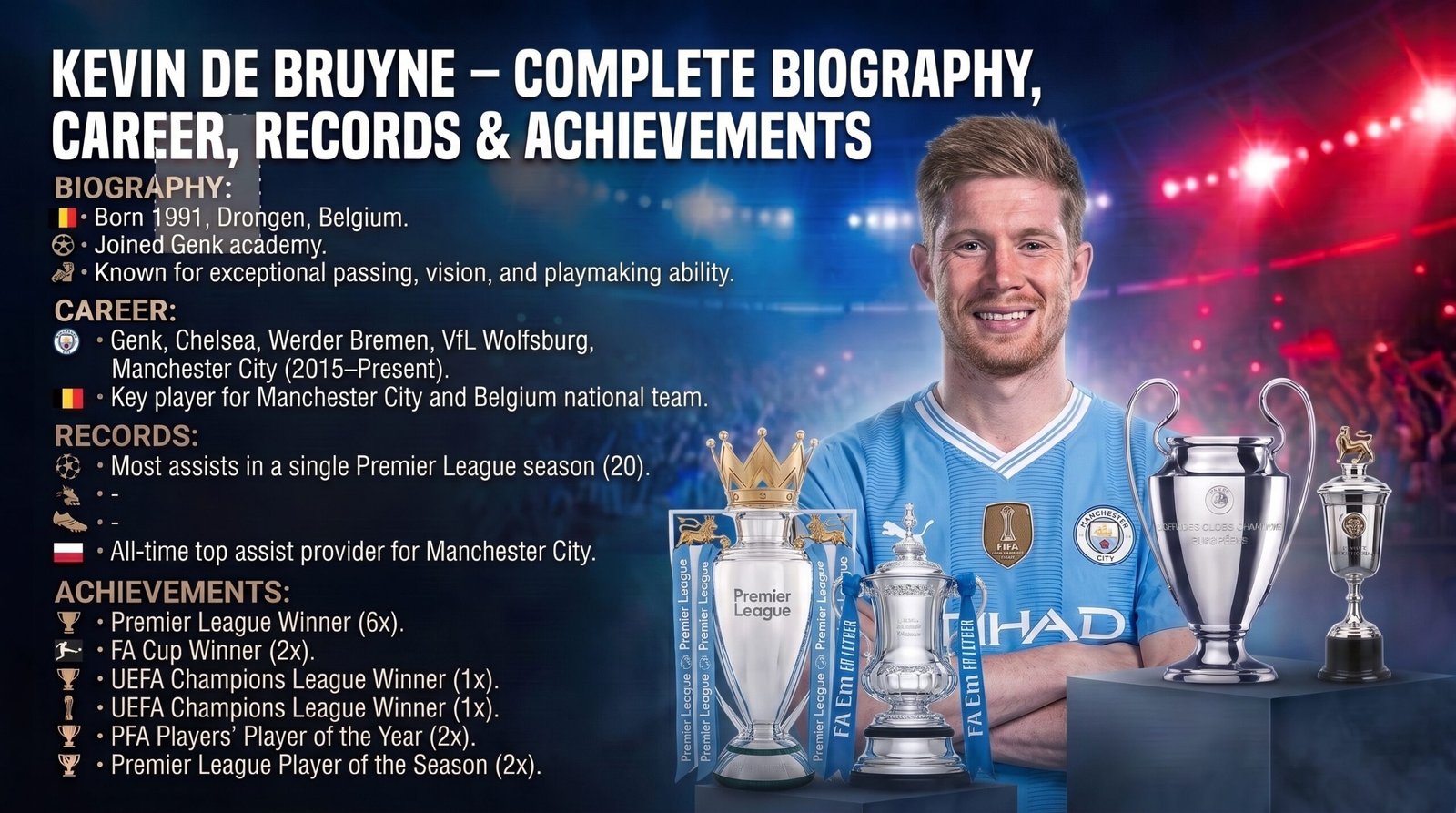
Introduction
This Kevin De Bruyne biography explores the fascinating journey of a pale, quietly intense boy from the Belgian municipality of Drongen who evolved into a global footballing titan. His path to the summit was far from linear. It is a story characterized by early rejections, highly publicized professional setbacks, and a subsequent ascent fueled by a burning, relentless determination. From his developmental years at Genk to an initial, frustrating stint in London, his career required immense psychological resilience before truly blossoming in the German Bundesliga.
However, it was his legendary tenure as the focal point for Kevin De Bruyne Manchester City squads under the tutelage of Pep Guardiola that cemented his legacy. He transformed into the ultimate engine of a team that dominated English football, accumulating domestic trebles, shattering points records, and finally capturing the elusive UEFA Champions League. Later, the transition to a new phase of his journey saw Kevin De Bruyne Napoli era begin, bringing his seasoned mastery to Italy’s Serie A. Simultaneously, as the talisman of Kevin De Bruyne Belgium teams across multiple FIFA World Cups, he carried the hopes of the Red Devils’ Golden Generation. This complete profile covers every aspect of his remarkable life, records, and indelible impact on the beautiful game.
Early Life and Childhood
Kevin De Bruyne was born on June 28, 1991, in Drongen, a picturesque sub-municipality of the city of Ghent in the Flemish region of Belgium. From the moment he could walk, Kevin displayed a singular, almost obsessive devotion to a football. In a quiet, suburban neighborhood, the young boy would spend hours relentlessly kicking a plastic ball against the walls of his family home. His early childhood was defined by this singular focus; he was not interested in typical childhood toys or television, choosing instead to hone his first touch and striking technique on the pavement.
One of the most famous anecdotes from his early life perfectly encapsulates his dedication and early bilateral development. Due to his powerful right-footed shots frequently destroying his family’s garden plants and heavily scuffing the brickwork, his parents eventually forbade him from using his dominant foot in the yard. Rather than stopping his practice, Kevin simply shifted the ball to his weaker left foot and continued kicking with equal ferocity. This forced adaptation at a highly malleable age is the direct origin of the terrifying ambidexterity that would later define his professional career.
Despite his slight, pale appearance and generally introverted demeanor off the pitch, young Kevin possessed a fiery, almost volcanic temperament on it. He absolutely abhorred losing, even in casual matches with friends. This fierce competitiveness often led to outbursts of frustration if his teammates did not share his relentless drive, a trait that signaled the immense internal standards he set for himself from an incredibly early age.
Family Background
The familial roots of Kevin De Bruyne are surprisingly international, adding a layer of cosmopolitan heritage to the Belgian international. He was born to Herve De Bruyne, a Belgian businessman, and Anna De Bruyne, a professional in petroleum engineering. While Herve provided the strict, disciplined Flemish background, his mother Anna’s history is notably unique. She was born in Burundi, a country in East Africa, and spent a significant portion of her developmental years growing up in Ealing, West London, due to her English father.
This lineage meant that Kevin De Bruyne was technically eligible to represent the national teams of Belgium, Burundi, or England. His mother’s English background meant that the De Bruyne family frequently visited the United Kingdom during Kevin’s childhood, visiting his grandparents in London. This early exposure to English culture and the English language made his eventual transitions to the Premier League significantly smoother from a cultural standpoint.
Herve and Anna provided a highly supportive but deeply grounded environment for their son. They ensured that his footballing obsessions did not completely eclipse his education, instilling a sense of professionalism and quiet dignity. Even as Kevin ascended to global superstardom, his parents deliberately remained out of the media spotlight, preferring to support him quietly from the stands rather than engaging in the sensationalism that often surrounds the families of elite athletes.
Growing Up in Drongen, Belgium
Drongen provided a tranquil backdrop for a boy consumed by a chaotic passion for football. The local amateur club, KVV Drongen, was where Kevin first officially laced up his boots in an organized setting. He joined their youth setup in 1997 at the age of six. It was immediately apparent to the local coaches that the boy was operating on a completely different cognitive and technical frequency than his peers. He saw passes before they materialized and possessed a striking technique that belonged to players twice his age.
His childhood in Drongen was characterized by an intense routine: school, football training, and more football in the garden until the sun went down. Unlike many modern academy players who are overly pampered from a young age, Kevin’s early environment was grounded in the realities of grassroots Belgian football. The pitches were often muddy, the weather unforgiving, and the local competition intensely physical.
The local community quickly recognized that they had a prodigy in their midst. However, Drongen could only provide so much of a challenge. Realizing that his talent was outgrowing the local infrastructure, his parents and youth coaches facilitated a move to the academy of the major regional club, KAA Gent, in 1999. This move marked the end of his purely recreational childhood football and the beginning of his formalized path toward professionalism.
Youth Career
Kevin’s time at KAA Gent (1999–2005) served as his introduction to elite youth development. He spent six years refining his tactical understanding and physical conditioning. However, his most pivotal developmental transition occurred when he made the bold decision at age 14 to leave Gent and join the academy of KRC Genk. Genk’s youth academy was widely regarded as one of the finest in Belgium, and it offered a clearer pathway to the senior squad.
Moving to Genk required Kevin to leave his family home in Drongen and move to a different region of Belgium. Because the commute was too long, he was placed with a foster family in the city of Genk. This period provided the most defining psychological crucible of his life. After his first year in the academy, he returned home for the summer holidays, believing he had integrated well. However, upon arrival, his mother broke devastating news to him in tears: his foster family had informed the club they did not want him back. They claimed his personality was too difficult, too quiet, and too intense.
This rejection shattered the 15-year-old. It was not a rejection of his footballing ability, but a rejection of who he was as a person. Rather than folding, De Bruyne channeled this profound hurt into an apocalyptic motivation. He returned to Genk, moved into a youth hostel, and approached his football with a cold, ruthless fury. In one of his first youth matches following the rejection, he came on as a substitute in the second half and scored five spectacular goals. It was a violent declaration of intent. When the foster family subsequently tried to reconcile, Kevin coldly refused them. That singular moment of rejection forged the icy, uncompromising winning mentality that would define his entire career.
Professional Debut
Fueled by his extraordinary performances in the youth ranks, De Bruyne’s promotion to the KRC Genk first team was inevitable. He officially broke into the senior squad during the 2008–09 season. His professional debut came on May 9, 2009, in a Belgian Pro League match against Charleroi, which Genk lost 3-0. Despite the result, the 17-year-old midfielder showcased flashes of the vision and composure that would become his trademarks.
The following season (2009–10), De Bruyne began to establish himself as a regular fixture in the Genk starting lineup. He scored his first professional goal in February 2010, a crucial strike that secured a 1-0 victory against Standard Liège. The raw, unfiltered talent of the young playmaker was beginning to impact senior matches directly, and the Belgian media quickly heralded him as the brightest prospect to emerge from the domestic league in years.
Rise at Genk
The 2010–11 season proved to be the true breakout year for Kevin De Bruyne at KRC Genk. Operating primarily on the wings or as an advanced playmaker, he became the creative heartbeat of the team. His incredible engine, combined with a seemingly telepathic ability to find his strikers, drove Genk to a phenomenal campaign. He registered five goals and 16 assists in 32 league appearances, numbers that were unheard of for a teenager in the Belgian top flight.
His contributions culminated in Genk winning the Belgian Pro League championship for only the third time in the club’s history. De Bruyne was the undisputed catalyst of this title run. He had evolved from a promising academy prospect into a dominant force capable of dictating the tempo of high-stakes championship matches. His performances in both domestic competitions and the UEFA Champions League qualifying rounds put all of Europe’s elite clubs on high alert.
By the end of the 2011–12 season, where he contributed another 8 goals and 14 assists, it was clear that the Belgian league could no longer contain his ambition or his talent. A major transfer to one of Europe’s top five leagues was imminent, and a club from London, familiar with his mother’s background, won the race for his signature.
Chelsea Struggles and Werder Bremen Loan
On January 31, 2012, English Premier League giants Chelsea FC announced the permanent signing of Kevin De Bruyne for a fee reported to be around £7 million. He remained at Genk for the remainder of that season before officially joining the London club in the summer. De Bruyne arrived at Stamford Bridge with dreams of conquering English football, but his initial experience in London would become one of the most infamously mismanaged periods in Premier League history.
Upon his arrival, Chelsea decided that the young Belgian needed top-flight experience elsewhere to further his development. In August 2012, he was sent on a season-long loan to Werder Bremen in the German Bundesliga. In Germany, De Bruyne was an absolute revelation. Given the freedom to pull the strings in midfield, he thrived in the tactical openness of the Bundesliga, scoring 10 goals and providing 9 assists in 33 appearances. He was arguably the most impactful young player in Germany that season, proving he was entirely ready for elite-level football.
However, returning to Chelsea for the 2013–14 season under the management of José Mourinho proved disastrous. Mourinho favored a more rigid, defensive tactical setup and frequently publicly criticized De Bruyne’s work ethic in training. The breaking point occurred when Mourinho called De Bruyne into his office to compare his statistics unfavorably with those of Willian, Oscar, Mata, and Schürrle. Recognizing that he would never be given a fair chance under Mourinho, a defiant De Bruyne demanded an immediate transfer. He made just three league appearances for Chelsea before forcing an exit in January 2014, choosing regular playing time over the prestige of sitting on a Chelsea bench.
Breakthrough at Wolfsburg
In January 2014, VfL Wolfsburg secured De Bruyne’s services for a fee of £18 million. Returning to the Bundesliga, a league where he already felt highly comfortable, allowed him to immediately shed the psychological weight of his Chelsea nightmare. The second half of the 2013–14 season saw him establish himself within the Wolfsburg system, but it was the subsequent 2014–15 season that catapulted him into the stratosphere of world football.
During the 2014–15 campaign, De Bruyne delivered one of the greatest individual seasons in the history of German football. He was an unstoppable creative force, dictating play with sweeping cross-field passes and lethal through-balls. He finished the Bundesliga season with 10 goals and an astonishing 21 assists, a new league record that shattered expectations. His vision carved open defensive structures week after week, leading Wolfsburg to a highly impressive second-place finish behind Bayern Munich.
His masterpiece of a season was crowned in the DFB-Pokal final against Jürgen Klopp’s Borussia Dortmund. De Bruyne scored a sensational goal to help Wolfsburg secure a 3-1 victory, lifting the prestigious trophy. Consequently, he was overwhelmingly voted the Footballer of the Year in Germany for 2015. He had completely vindicated his decision to leave Chelsea, proving unequivocally that he was not an English football reject, but a generational talent ready to dominate the globe.
Transfer to Manchester City
Having conquered Germany, the Premier League beckoned once again. In August 2015, Manchester City announced the signing of Kevin De Bruyne for a club-record fee of £54 million. The transfer was met with widespread skepticism by elements of the British sporting press. Pundits openly questioned the massive fee, labeling him a “Chelsea reject” and suggesting he lacked the mental fortitude for the English game based on his brief, mismanaged stint under Mourinho.
De Bruyne answered his critics immediately and emphatically. Under manager Manuel Pellegrini, he hit the ground running, scoring and assisting at a prolific rate. He injected a new dimension of verticality and speed into Manchester City’s attacks. Within months, it was abundantly clear that City had not overpaid; they had executed one of the greatest acquisitions in the history of the Premier League. The “Chelsea reject” narrative was completely obliterated by the sheer, undeniable brilliance of his on-pitch performances.
In his debut season, he scored 16 goals and provided 13 assists across all competitions, including a memorable, tie-winning goal against Paris Saint-Germain in the Champions League quarter-finals. However, while he was brilliant under Pellegrini, the true evolution of Kevin De Bruyne was yet to come, awaiting the arrival of a manager who would fully unlock his profound tactical intelligence.
Manchester City Era: Becoming a Premier League Legend
The appointment of Pep Guardiola as Manchester City manager in the summer of 2016 altered the trajectory of De Bruyne’s career forever. Guardiola immediately recognized De Bruyne’s unique spatial awareness and shifted him from a traditional number 10 or winger into a deeper, “free 8” midfield role. Operating heavily in the right half-space—the channel between the opponent’s center-back and full-back—De Bruyne found the perfect zone to deploy his devastating passing range.
Under Guardiola, Kevin De Bruyne Manchester City squads became the most dominant force in English football history. He was the undisputed orchestrator of the legendary “Centurions” team in the 2017–18 season, which accumulated a historic 100 Premier League points. His signature move—a whipped, early, devastatingly accurate cross from the right flank to the far post—became practically unplayable for Premier League defenses. He followed this up by driving City to an unprecedented domestic treble in the 2018–19 season, despite battling knee injuries.
His individual brilliance was consistently recognized. In the 2019–20 season, he equaled Thierry Henry’s long-standing Premier League record of 20 assists in a single campaign, resulting in him winning the prestigious PFA Players’ Player of the Year award. He won the award again in 2020–21. Year after year, De Bruyne demonstrated a level of consistent, elite-level playmaking that elevated him above his peers, claiming five Premier League titles by 2023 and cementing himself as perhaps the greatest midfielder to ever grace the English top flight.
The Treble-Winning Season (2022-23)
The 2022–23 season represented the ultimate climax of the Kevin De Bruyne Manchester City project. The arrival of the lethal Norwegian striker Erling Haaland provided De Bruyne with the ultimate focal point for his creativity. The two developed an instant, telepathic connection. De Bruyne’s ability to locate Haaland’s runs behind defensive lines resulted in a historically prolific partnership, tearing domestic and European opponents to shreds.
De Bruyne was instrumental in City’s relentless pursuit of the continental treble. In the Premier League run-in, his two-goal masterclass against title rivals Arsenal at the Etihad Stadium effectively secured the championship. In the UEFA Champions League, his majestic, long-range equalizer against Real Madrid at the Santiago Bernabéu in the semi-final first leg shifted the momentum entirely in City’s favor, leading to a demolition in the second leg.
The Champions League final in Istanbul against Inter Milan brought a cruel sense of déjà vu, as De Bruyne was forced off with a severe hamstring tear in the first half—mirroring his facial injury exit in the 2021 final. Despite the personal heartbreak of not completing the match, his teammates secured the 1-0 victory. Winning the Champions League, Premier League, and FA Cup immortalized the squad, and De Bruyne stood at the absolute epicenter of that historic achievement.
Final Years at City and Transfer to Napoli (2025-26)
The aftermath of the Treble season required immense physical rehabilitation. The hamstring tear sustained in Istanbul required complex surgery, causing De Bruyne to miss the first half of the 2023–24 campaign. However, he returned with characteristic brilliance, instantly reminding the league of his quality and helping City secure an unprecedented fourth consecutive Premier League title. The following 2024–25 season saw him gracefully navigate his final year under contract at the Etihad, surpassing long-standing assist records and bidding a slow, emotional farewell to the English game.
In the summer of 2025, at the age of 34, a monumental shift occurred. Seeking a completely different cultural and tactical challenge, De Bruyne decided to leave Manchester City upon the expiration of his contract. Rejecting lucrative offers from the Saudi Pro League, he shocked the footballing world by signing a multi-year deal with Napoli on a free transfer. The move to Italy represented a desire to test his playmaking intellect in the notoriously tactical waters of Serie A.
His departure from Manchester City marked the end of a golden decade. He left the club as their all-time leading assist provider, a multi-time champion, and a player widely acknowledged as one of the greatest to ever wear the sky-blue shirt. The emotional farewell at the Etihad Stadium cemented his status not just as a great player, but as a Manchester City legend.
Serie A Journey with Napoli
The Kevin De Bruyne Napoli era began in August 2025 with massive fanfare at the Stadio Diego Armando Maradona. The Neapolitan faithful, known for their fiery passion and deep appreciation of footballing maestros, embraced the Belgian instantly. Adapting to the slower, more deeply structured tactical systems of Serie A, De Bruyne transitioned from a dynamic box-to-box engine into a deeply positioned orchestrator, akin to an advanced regista.
Under the rigorous tactical demands of Italian football, De Bruyne demonstrated that his footballing IQ was immune to physical aging. He expertly dictated the tempo of matches, using his immense passing range to unlock deep-sitting Italian defenses. Through the 2025–26 season, he provided a steady stream of elite chances for Napoli’s attacking line, proving that his world-class vision translated seamlessly to a new league. By 2026, he had established himself as a revered veteran in Italy, bringing invaluable championship experience and elite composure to a fiercely competitive Napoli squad.
Belgium National Team Career
To examine the Kevin De Bruyne career is to understand his immense burden and brilliance with the Belgium national team. He made his full international debut in August 2010 in a friendly against Finland. As he matured, he emerged as the undisputed creative nucleus of the famous Belgian “Golden Generation,” a squad featuring world-class talents like Eden Hazard, Romelu Lukaku, Thibaut Courtois, and Vincent Kompany.
Over a span of more than 15 years, De Bruyne has amassed well over 120 international caps, placing him among the highest appearance-makers in the history of the Red Devils. He assumed the captaincy following the retirement of older veterans, bearing the massive psychological weight of carrying a small nation’s expectations on the global stage. Through varying managerial setups—from Marc Wilmots to Roberto Martínez and Domenico Tedesco—De Bruyne remained the one un-droppable, irreplaceable asset in the Belgian system.
His performances for the national team have often been spectacular, dictating the flow of high-stakes international matches with the same authority he displayed at the club level. He has scored crucial goals and provided a myriad of assists in qualification campaigns, solidifying his legacy as arguably the greatest player in the history of Belgian football.
International Tournaments
Kevin De Bruyne’s relationship with major international tournaments has been a saga of thrilling peaks and heartbreaking near-misses. He was highly influential at the 2014 FIFA World Cup in Brazil, his first major tournament, where he scored a crucial extra-time goal against the United States in the Round of 16 to secure Belgium’s passage to the quarter-finals.
The 2018 FIFA World Cup in Russia represented the absolute peak of the Golden Generation. De Bruyne was masterful throughout the tournament. His defining international moment occurred in the quarter-final against pre-tournament favorites Brazil. Playing in a specialized false-nine role, De Bruyne struck a vicious, arrowing shot from outside the box into the bottom corner to secure a historic 2-1 victory. He was subsequently named to the tournament’s Fan Dream Team as Belgium secured a third-place finish, their best ever result at a World Cup.
Subsequent tournaments brought frustration. Euro 2020 saw him suffer an ankle injury that severely hampered his impact against Italy in the quarter-finals. The 2022 World Cup in Qatar was a disaster for the squad, marked by internal friction and a shocking group-stage exit, heavily colored by De Bruyne’s brutally honest assessment that the team was “too old” to win. However, remaining dedicated to his country, a 34-year-old De Bruyne proudly led a revitalized, younger Belgian squad into the 2026 FIFA World Cup in North America, serving as the veteran anchor and captain aiming for one final shot at international glory.
Playing Style
Kevin De Bruyne is the archetype of the modern, complete midfielder. His playing style defies traditional categorization. He is not a classic number 10 who lingers solely behind the striker, nor is he a traditional deep-lying playmaker or a rugged box-to-box enforcer. Instead, he represents a hybrid of all three. He possesses the physical engine to cover immense ground, the tactical discipline to hold defensive shapes, and an unparalleled offensive intellect.
His vision is frequently described by managers and analysts as possessing a 360-degree quality. De Bruyne processes the geometrical arrangements of players on the pitch faster than anyone else, allowing him to execute passes that seem entirely illogical until the exact moment the ball perfectly meets the striker’s run. He does not simply pass the ball; he passes it with a highly specific weight and spin designed to perfectly suit the receiver’s stride, making him the ultimate facilitator.
Furthermore, his ability to execute high-speed, high-precision actions sets him apart. Many playmakers require time and space to pick a pass. De Bruyne is completely capable of threading a 40-yard through-ball through a needle’s eye while sprinting at full speed during a counter-attack. This combination of physical momentum and delicate execution makes defending him almost impossible in transition.
Strengths and Skills
The foremost strength of Kevin De Bruyne is his passing repertoire. His signature skill is the early, whipped cross delivered from the right half-space, bypassing the entire defensive line and dropping perfectly onto the foot or head of an attacker at the far post. This delivery is struck with such ferocious pace and curve that it completely removes the opposition goalkeeper from the equation.
Another monumental strength is his ball-striking ability with both feet. Because of his intense childhood practice, he can shoot and pass with elite power and accuracy using either his right or left foot. This makes him highly unpredictable on the edge of the penalty area; if a defender shows him onto his weaker foot, he is entirely capable of unleashing a long-range screamer into the top corner.
His tactical adaptability is highly praised by Pep Guardiola. He understands pressing triggers flawlessly and leads by example in counter-pressing situations, quickly hunting the ball down after losing possession. His raw physical stamina and robust upper body strength also allow him to ride tackles and maintain possession under severe physical duress.
Training, Fitness, and Diet
To sustain his explosive, high-intensity playing style over a decade in the rigorous Premier League, De Bruyne evolved his approach to fitness and conditioning. While naturally gifted with a large lung capacity, he worked extensively on his core strength and lower body power. This allowed him to generate immense power on his passes and shots with very little backlift.
Throughout his mid-to-late twenties, he began working with specialized sports scientists to manage his susceptibility to muscle fatigue, particularly his hamstrings, which bore the brunt of his sudden bursts of acceleration. His training protocols heavily feature biomechanical analysis to ensure his running gait remains efficient and protective of his joints.
His dietary approach is highly disciplined, overseen by professional nutritionists. He strictly monitors his carbohydrate intake to fuel his immense in-game running statistics, while heavily relying on anti-inflammatory foods to accelerate recovery between matches. Unlike players who frequently engage in the nightlife of major cities, De Bruyne’s recovery periods are strictly structured around rest, sleep, and family time, forming the bedrock of his longevity.
Business Ventures and Sponsorships
Off the pitch, Kevin De Bruyne is recognized as one of the most commercially astute footballers in the world. He made a groundbreaking decision regarding his management by signing with Roc Nation Sports, the agency founded by American music mogul Jay-Z, vastly expanding his brand reach in North America and beyond.
He is a highly analytical businessman. Famously, during his contract renegotiations with Manchester City in 2021, rather than using a traditional agent, he commissioned a team of data analysts to model his statistical value to the club and the team’s future probability of success with him in the squad. This revolutionary use of big data in contract negotiations earned him immense respect in the sports business world.
His sponsorship portfolio is carefully curated. He holds a long-standing, highly lucrative boot deal with Nike, frequently headlining their Phantom boot campaigns. Furthermore, he is the primary face of McDonald’s in Belgium, appearing in numerous highly popular national ad campaigns. He has also invested his wealth into real estate and sports technology startups, ensuring his financial legacy extends far beyond his playing days.
Charity and Community Work
Despite his massive wealth and global profile, De Bruyne remains deeply connected to philanthropic efforts. He is a prominent global ambassador for the Special Olympics, actively participating in campaigns to promote inclusivity in sports for athletes with intellectual disabilities. He frequently dedicates his time to meeting Special Olympics athletes and funding local programs in Belgium.
He is also heavily involved with Make-A-Wish, regularly hosting children with life-threatening illnesses at training grounds and stadiums, ensuring they experience moments of profound joy. In his hometown of Drongen, he established the ‘KDB Cup’, a prestigious international youth football tournament. He personally funds and oversees the event, ensuring that the next generation of footballing talent has a premier platform to showcase their skills.
During his time in Manchester, and later in Naples, De Bruyne and his family consistently made unpublicized visits to local children’s hospitals, delivering gifts and spending time with young patients, demonstrating a quiet but profound commitment to giving back to the communities that support him.
Personal Life
The fiery intensity Kevin De Bruyne displays on the pitch stands in stark contrast to his quiet, highly private personal life. He is married to Michèle Lacroix. The couple began dating in 2014 during his time at Wolfsburg and were married in a lavish but private ceremony in Sorrento, Italy, in June 2017. Michèle has been a constant, grounding presence throughout his meteoric rise.
They are the parents of three children: a son named Mason Milian (born in 2016), a second son named Rome (born in 2018), and a daughter named Suri (born in 2020). De Bruyne is a devoted family man, frequently stating that becoming a father completely shifted his perspective on life, allowing him to leave the pressures of elite football at the training ground and find peace at home.
Away from football, De Bruyne is an avid gamer, occasionally streaming games to interact with fans. He is also a keen follower of American sports, particularly the NBA, and enjoys traveling to the United States during the football off-season. His lifestyle is deliberately low-profile, eschewing the glamorous celebrity party scene in favor of quiet nights at home with his wife and children.
Social Media Influence
Kevin De Bruyne commands an immense global following across social media platforms, with tens of millions of followers on Instagram, X (formerly Twitter), and TikTok. However, his approach to digital media is highly curated and professional. His profiles primarily feature match photography, training updates, sponsorship activations, and wholesome glimpses into his family life.
Despite his controlled online presence, he has inadvertently created massive viral moments. The most famous was his furious “Let me talk!” outburst directed at David Silva during a tense Champions League match, which immediately became a massive internet meme. During the global lockdowns of 2020, he showed a lighter side of his personality, participating in TikTok challenges with his family and engaging with his younger fanbase, further solidifying his status as a highly relatable global superstar.
Career Statistics
A quick glance at Kevin De Bruyne records reveals the sheer volume of his impact on the modern game. The following table details his senior club statistics across all competitions, reflecting his journey from Belgium to Italy up to the start of the 2026 season.
| Club | League | Tenure | Official Appearances | Goals |
|---|---|---|---|---|
| KRC Genk | Belgian Pro League | 2008–2012 | 113 | 17 |
| Chelsea FC | Premier League | 2012–2014 | 9 | 0 |
| Werder Bremen (Loan) | Bundesliga | 2012–2013 | 34 | 10 |
| VfL Wolfsburg | Bundesliga | 2014–2015 | 73 | 20 |
| Manchester City | Premier League | 2015–2025 | 382 | 102 |
| Napoli | Serie A | 2025–Present | 18 | 5 |
| Belgium National Team | International | 2010–Present | 123 | 38 |
Records
The extent of Kevin De Bruyne achievements is etched permanently into the record books of European football. He has redefined the statistical benchmarks for creative midfielders.
- Most Assists in a Premier League Season: Registered 20 assists in the 2019–20 season, matching Thierry Henry’s all-time record.
- Fastest Player to 100 Premier League Assists: Reached the milestone in just 237 games, completely shattering Cesc Fàbregas’s previous record.
- Manchester City’s All-Time Assist Leader: Surpassed David Silva to become the most prolific creator in the club’s entire history (over 170 assists).
- Bundesliga Assist Record (Single Season): Provided 21 assists for Wolfsburg in the 2014–15 season, setting a record that stood for years.
- Four-Time Premier League Playmaker of the Season: Won the award for most assists in the PL in 2018, 2020, 2022, and 2023.
- Most Chances Created in a Single PL Season: Consistently topped the metric for open-play chances created throughout his City tenure.
Awards and Honors
De Bruyne’s trophy cabinet reflects a decade of supreme domestic and continental dominance. He has been universally recognized by his peers, managers, and the media as a generational talent.
| Award / Trophy | Frequency | Notable Years |
|---|---|---|
| Premier League Title | 6x | 2017–18, 2018–19, 2020–21, 2021–22, 2022–23, 2023–24 |
| UEFA Champions League | 1x | 2022–23 |
| PFA Players’ Player of the Year | 2x | 2019–20, 2020–21 |
| Premier League Player of the Season | 2x | 2019–20, 2021–22 |
| UEFA Champions League Midfielder of the Season | 1x | 2019–20 |
| German Footballer of the Year | 1x | 2015 |
| FA Cup | 2x | 2018–19, 2022–23 |
| Belgian Pro League Title | 1x | 2010–11 |
Memorable Matches
A player of De Bruyne’s caliber inevitably leaves a trail of iconic performances. His masterclass against Brazil in the 2018 World Cup quarter-final is legendary in Belgium. Deployed in an unfamiliar advanced role by Roberto Martínez, he systematically dismantled the Brazilian midfield, capping his performance with a stunning strike to send Belgium to the semi-finals.
In the Premier League, his four-goal demolition of Wolverhampton Wanderers in May 2022 stands out. With the title race on a knife-edge, De Bruyne stepped up and scored a blistering hat-trick within the first 24 minutes using his “weaker” left foot, adding a fourth later in the game. It was a complete display of ruthless finishing that essentially secured the championship for Manchester City.
His performance against Real Madrid in the 2023 Champions League semi-final first leg at the Bernabéu is another historic chapter. In a tense, suffocating match where City trailed 1-0, De Bruyne stepped up and hit an unstoppable, low-driven rocket from outside the box to equalize, changing the emotional complexion of the entire tie and paving the way for City’s eventual Treble.
Greatest Assists and Goals
De Bruyne’s highlight reel of passes is practically unmatched. Perhaps his most famous assist came against Stoke City in 2017. Gathering the ball on the right flank, he unleashed a sweeping, grounded pass that impossibly bypassed five Stoke defenders, wrapping around the backline directly into the path of Leroy Sané for a tap-in. It was a pass that defied the laws of physics and spatial geometry.
Another iconic assist occurred against Aston Villa in 2021, where he executed a flawless outside-of-the-boot (trivela) cross that curved around the entire defense, landing perfectly for Ruben Dias to score. It showcased his supreme technical mastery of the football.
When it comes to goals, his strike against Chelsea at Stamford Bridge in 2017—a searing, left-footed drive from outside the box—served as the ultimate, poetic revenge against the club that had discarded him. His catalogue is filled with long-range thunderbolts, perfectly demonstrating that he is as lethal at finishing attacks as he is at orchestrating them.
Leadership and Captaincy
Kevin De Bruyne is not a stereotypical, chest-thumping captain. His leadership style is deeply rooted in demanding absolute perfection through his own actions. When he wears the armband for club or country, he leads by setting an uncompromising technical standard. If the tempo of a match drops, it is De Bruyne who demands the ball, aggressively driving forward and forcefully increasing the game’s intensity.
His teammates respect him immensely because of his blunt, honest communication. He does not mince words in the dressing room if standards are slipping. This demanding nature, forged by his early rejections, ensured that the complacency that ruins many top teams never infected the Manchester City or Belgian locker rooms while he was at the helm.
Legacy
“He sees things that others do not see. Kevin is one of the best players I have ever seen in my life. He can do absolutely everything. He is a master.”
— Pep Guardiola on Kevin De Bruyne
Kevin De Bruyne’s legacy is firmly established at the very pinnacle of modern football history. He is the standard by which all contemporary playmakers are judged. In an era increasingly dominated by rigorous tactical systems and physical athletes, De Bruyne proved that supreme intelligence, vision, and technique could still dismantle any defensive structure.
He overcame severe early-career setbacks to become the defining midfielder of the Premier League’s most dominant dynasty. His transition to Napoli and his enduring presence with the Belgian national team further highlight his longevity and adaptability. When the history of football in the 21st century is analyzed, Kevin De Bruyne will be remembered not just as a great player, but as the ultimate architect of the beautiful game.
20 Interesting Facts
- His mother was born in Burundi and grew up in London, making him eligible to play for England.
- As a child, he supported Liverpool and his idol was Michael Owen.
- He wrote a children’s book titled Keep It Simple, co-authored with a Belgian writer, aimed at inspiring young readers.
- He is an avid bird watcher and actively supports wildlife conservation efforts in Belgium.
- De Bruyne speaks fluent Dutch, French, English, and German.
- He famously negotiated his 2021 Manchester City contract himself, using a team of data analysts instead of an agent.
- During his youth career, a foster family rejected him for being “too difficult,” an event he cites as the defining motivation of his life.
- He holds the Bundesliga record for most assists in a single season (21).
- He joined Jay-Z’s agency, Roc Nation Sports, in 2019 to manage his commercial profile.
- He suffered severe facial fractures during the 2021 Champions League Final after a collision with Antonio Rüdiger.
- He is the only player alongside Thierry Henry to record 20 assists in a single Premier League season.
- He has his own annual youth football tournament in his hometown, the KDB Cup.
- De Bruyne’s favorite cheat meal is a large portion of traditional Belgian frites with mayonnaise.
- He was named in the FIFA FIFPro World11 on multiple occasions.
- He left Manchester City in 2025 as the club’s all-time leading assist provider.
- He made a cameo appearance in a music video for a popular Belgian rap group.
- He famously yelled “Let me talk!” at teammate David Silva during a match, creating a massive viral meme.
- De Bruyne is a massive fan of the NBA and frequently attends games during his holidays.
- At Napoli, he adapted to the Italian lifestyle by taking intensive cooking classes to learn authentic Neapolitan cuisine.
- He led Belgium into the 2026 World Cup as captain, his fourth appearance at the global tournament.