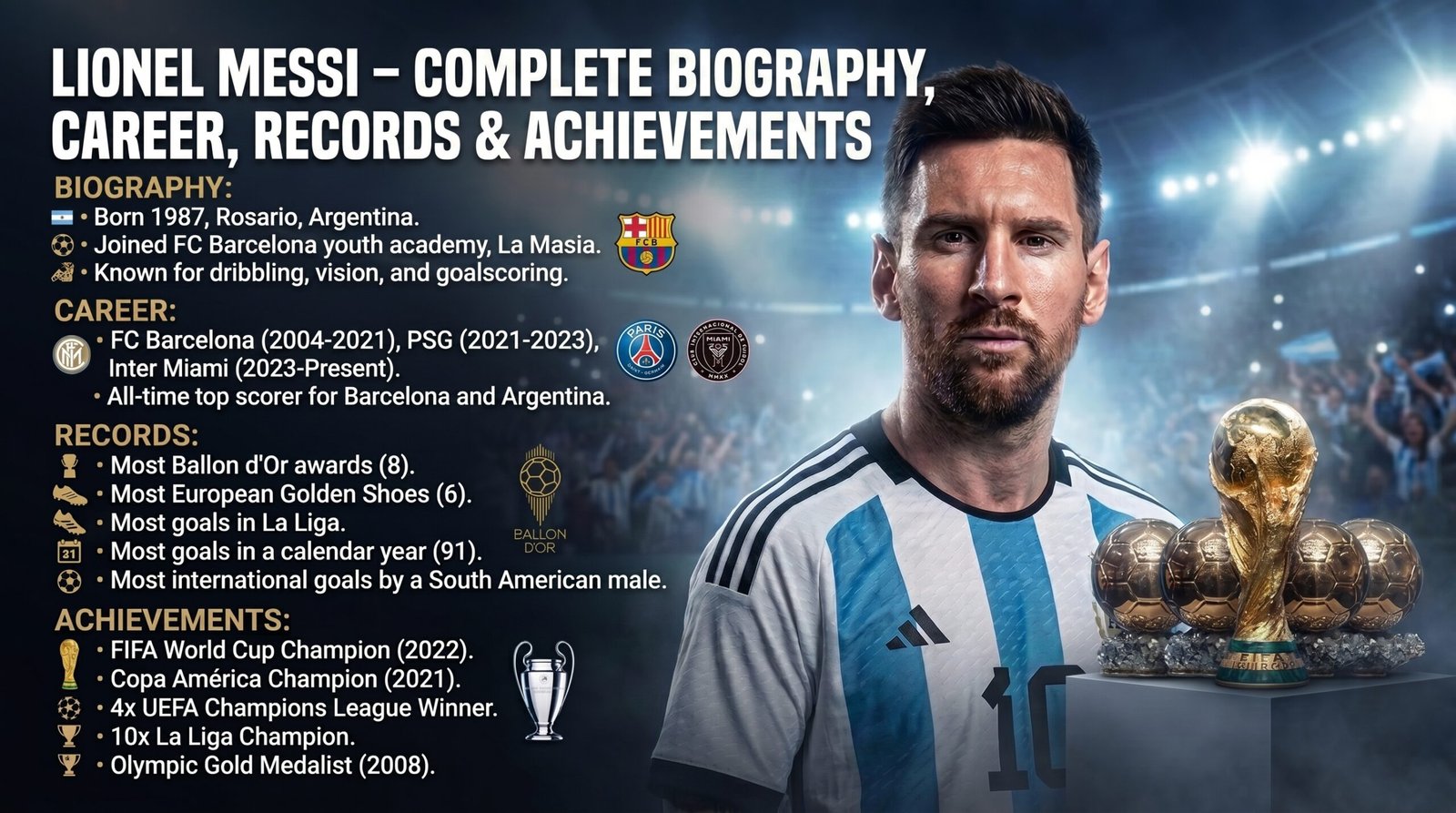
Introduction
Lionel Andrés Messi stands as a transcendent figure in the history of global sports, widely regarded by pundits, peers, and fans as the greatest football player of all time. A prodigious talent whose career reads like a mythological epic, Messi has spent over two decades redefining the parameters of athletic excellence. Armed with an otherworldly left foot, a preternatural low center of gravity, and a visionary understanding of space and geometry on the pitch, he has shattered virtually every significant individual and collective record in the sport. From his beginnings as a diminutive, medically fragile child in Argentina to his coronation as a World Cup champion, his narrative is a masterclass in perseverance and pure, unadulterated genius.
As of 2026, advancing gracefully through his late thirties with Inter Miami and the Argentine national team, Messi’s statistical footprint borders on the incomprehensible. With over 900 official career goals, an unmatched eight Ballon d’Or awards, and the status of being the most decorated player in the history of football with 48 collective trophies, his dominance is absolute. Furthermore, his performances during the 2026 FIFA World Cup have rewritten the record books once again, elevating him to the absolute summit as the all-time leading goalscorer in the history of the tournament. Beyond the numbers, however, Messi’s true legacy lies in the sheer aesthetic joy he brings to the game—a player who transforms a highly structured, physical sport into fluid, breathtaking art.
Early Life and Childhood
Born on June 24, 1987, in the city of Rosario, located in the central province of Santa Fe, Argentina, Lionel Messi grew up in a tight-knit, working-class environment. From the moment he could walk, he was inseparable from a football. His earliest childhood memories revolve around kicking deflated balls against the walls of his modest family home in the Barrio La Bajada neighborhood. At just four years old, he joined local club Abanderado Grandoli, where he was coached by his father. It was here that his maternal grandmother, Celia, first recognized his extraordinary potential. She would often stand on the sidelines, fiercely advocating for the tiny boy to be allowed to play against much larger, older children.
However, his early life was marred by a significant physical setback. At the age of 10, Messi was diagnosed with Growth Hormone Deficiency (GHD), a rare medical condition that severely stunted his physical development. By this point, he was significantly smaller than all of his peers, a biological disadvantage that threatened to end his footballing dreams before they could truly begin. The treatment required daily, painful injections of synthetic human growth hormone into his legs, a regimen that forced an incredibly young Messi to develop profound psychological resilience and discipline.
Family Background
The foundation of Lionel Messi’s success is intrinsically tied to his family. He is the third of four children born to Jorge Messi, a manager at an active local steel factory, and Celia Cuccittini, who worked in a magnet manufacturing workshop and occasionally took on house-cleaning jobs to help support the family. His older brothers, Rodrigo and Matias, were his first teammates and fiercest competitors in the informal street matches that defined his youth, while his younger sister, Maria Sol, completed the close-knit family unit. The household was entirely devoted to football, functioning as an incubator for his raw talent.
When the devastating diagnosis of Growth Hormone Deficiency was delivered, the financial burden placed on the family was immense. The treatment cost approximately $1,000 per month, a staggering sum for a working-class Argentine family undergoing the severe national economic crisis of the late 1990s and early 2000s. Jorge Messi’s health insurance initially covered a fraction of the costs, but as the economic situation in Argentina deteriorated, the funding evaporated. The family’s unwavering determination to secure the funds necessary to pay for his medical treatment became the driving catalyst for the defining journey of his life: the migration to Europe.
Growing Up in Rosario, Argentina
Rosario is a city that breathes football, characterized by a fierce, uncompromising sporting culture. It is the birthplace of legendary figures like Marcelo Bielsa and Cesar Luis Menotti, and the city’s identity is violently split between its two massive rival clubs: Newell’s Old Boys and Rosario Central. Growing up in this fervent atmosphere, Messi honed his skills in the “potreros”—the uneven, often dirt-covered makeshift street pitches scattered throughout his neighborhood. In these unregulated spaces, there were no referees and physical intimidation was rampant.
Because he was so physically small due to his medical condition, the potreros taught the young Messi a vital survival skill: he had to be quicker, smarter, and technically flawless to avoid being brutally tackled by larger boys. He learned how to ride challenges, how to shift his body weight instantly to deceive defenders, and how to keep the ball glued to his left foot. These rugged, informal street games ingrained a sense of relentless, forward-thinking momentum in his playing style. He never dived or complained when fouled; he simply got back up and demanded the ball again, a trait that would come to define his professional career.
Newell’s Old Boys Youth Career
At the age of eight, Messi officially joined the youth system of Newell’s Old Boys, the Rosario club he fiercely supported. He became the centerpiece of an essentially invincible youth squad that became known throughout Argentina as “The Machine of ’87” (named after the year of their birth). During his time in the Newell’s academy, Messi’s talent was completely unmatched. Video footage from this era shows a microscopic child effortlessly weaving through entire opposing teams before casually slotting the ball past helpless goalkeepers.
His statistics at the youth level border on the absurd; it is documented that he scored nearly 500 goals during his time with the Newell’s academy. He became a local sensation, frequently invited to perform ball-juggling exhibitions at half-time during the Newell’s first-team matches, easily keeping the ball in the air for hundreds of touches to the delight of the crowd. However, as the cost of his GHD treatment became unsustainable, Newell’s Old Boys controversially declined to consistently fund the $1,000 monthly medical bills. Facing a dead end in his home country, Jorge Messi began reaching out to international contacts, seeking a club that would invest in his son’s health and undeniable potential.
Barcelona Youth Academy (La Masia)
In September 2000, a 13-year-old Lionel Messi traveled across the Atlantic to Catalonia for a trial with FC Barcelona, arranged by Argentine representatives Horacio Gaggioli and Josep Maria Minguella. First-team director Carles Rexach was instantly mesmerized. Legend dictates that after watching Messi play for mere minutes, Rexach knew the club had to sign him. However, the Barcelona board was highly hesitant to sign a foreign child, especially one requiring expensive medical intervention. Frustrated by the delays, Gaggioli issued an ultimatum, threatening to take Messi to rival club Real Madrid.
This led to one of the most famous moments in sports history. On December 14, 2000, meeting at the Pompeia tennis club, Rexach grabbed a paper napkin and hastily wrote out a makeshift contract, legally committing FC Barcelona to sign the boy and cover his medical bills in full. Messi moved to Spain, but the transition was agonizing. Living in the famed La Masia academy, he was incredibly homesick. Due to strict Spanish football federation rules, he was initially barred from playing in official youth matches. His mother and siblings eventually returned to Argentina, leaving a lonely, quiet teenager alone with his father in a foreign country. Yet, once he was cleared to play alongside future legends like Gerard Pique and Cesc Fabregas, his ascent through the academy ranks was meteoric and unstoppable.
Barcelona Senior Career
Lionel Messi’s senior career at Barcelona spans two decades and represents the most successful alignment of player and club in the history of football. He made his unofficial debut at just 16 years old in a friendly against Jose Mourinho’s Porto, but his official competitive debut arrived in October 2004 against local rivals Espanyol. On May 1, 2005, he scored his first senior goal against Albacete, beautifully chipping the goalkeeper following a brilliant scooped assist from his mentor, the legendary Brazilian playmaker Ronaldinho.
When Ronaldinho departed the club in 2008, Messi inherited the iconic number 10 shirt, signaling his transition from a prodigious winger into the undisputed focal point of the team. Over the next 13 years, he systematically dismantled every standing record in Spanish football. In 778 official appearances for the Blaugrana, he scored an incomprehensible 672 goals, becoming the highest goalscorer for a single club in football history, surpassing Pele’s long-standing record with Santos. He won 35 official trophies with Barcelona, providing the creative and clinical heartbeat for a team that is widely considered the greatest club side ever assembled.
Frank Rijkaard’s and Pep Guardiola’s Influence
Manager Frank Rijkaard was the architect of Messi’s early integration into the first team. Recognizing the physical fragility of the teenager, Rijkaard carefully managed his minutes, slowly introducing him to the intense physicality of La Liga. He deployed Messi primarily as a traditional right-winger, allowing him to utilize his explosive acceleration to cut inside onto his favored left foot. Rijkaard treated him with immense paternal care, protecting him from the harsh glare of the media and allowing his natural creativity to flourish without the burden of severe tactical constraints.
However, it was the arrival of Pep Guardiola in 2008 that elevated Messi from a world-class talent to an absolute sporting deity. Guardiola implemented a revolutionary tactical shift, moving Messi from the wing into the center of the pitch as a “False 9.” This masterstroke was famously unleashed against Real Madrid in May 2009, resulting in a historic 6-2 victory at the Santiago Bernabeu. By dropping deep into the midfield, Messi created an insurmountable numerical advantage, leaving opposing center-backs completely bewildered. Under Guardiola’s obsessive tactical guidance, Messi became the ultimate footballing weapon, acting simultaneously as the team’s primary playmaker and its most lethal goalscorer.
La Liga and Domestic Dominance
To examine Lionel Messi’s impact on La Liga is to look at a period of absolute tyranny. He completely monopolized the Spanish domestic league, leading Barcelona to an astonishing 10 La Liga titles. His consistency was terrifying; he treated the domestic championship as his personal playground, effortlessly dismantling deep defensive blocks week after week. He formed telepathic connections with midfield maestros Xavi Hernandez and Andres Iniesta, and later forged the most devastating attacking trident in history alongside Luis Suarez and Neymar (the “MSN”).
The pinnacle of his domestic dominance occurred during the 2011-2012 season, where he achieved statistical outputs that defy mathematical logic. In a single La Liga campaign, he scored 50 league goals in 37 appearances. He shattered Telmo Zarra’s all-time La Liga goalscoring record of 251 goals by the time he was 27 years old, eventually pushing his final league tally to an untouchable 474 goals. He also holds the all-time record for the most assists in La Liga history (192), proving that his domestic dominance was not merely about finishing, but about total offensive orchestration.
UEFA Champions League Triumphs
While domestic success became routine, the UEFA Champions League was the theater where Messi authored his most spectacular masterpieces. He is a four-time winner of Europe’s premier club competition. Though he missed the 2006 final due to a hamstring injury, his fingerprints were all over the team’s subsequent European conquests. In the 2009 final in Rome against Manchester United, he famously lost his boot while hanging in the air to score a towering header, emphatically answering critics who claimed he was too small to be effective in the air.
The 2011 Champions League final at Wembley Stadium, once again against Manchester United, is widely regarded as his magnum opus. He delivered a performance of such devastating quality—scoring from outside the box and orchestrating every attack—that United manager Sir Alex Ferguson later admitted his hands were shaking on the touchline because his team was being so thoroughly dismantled. In 2015, he guided Barcelona to another treble, humiliating Bayern Munich in the semi-finals by notoriously dropping defender Jerome Boateng to the turf with a lethal change of direction before elegantly chipping Manuel Neuer. He finished his Barcelona career with 120 Champions League goals, delivering unforgettable moments under the brightest lights.
Paris Saint-Germain (PSG) Era
The summer of 2021 brought the most shocking transfer in modern football history. Due to massive financial mismanagement by the previous Barcelona board and strict La Liga salary cap regulations, the club literally could not afford to register Messi’s new contract, even after he offered to reduce his salary by 50%. In a deeply emotional, tear-filled press conference, an absolutely devastated Messi bid farewell to the only club he had ever known. Days later, he arrived in the French capital to sign a two-year contract with Paris Saint-Germain.
His arrival in Paris caused a global frenzy, reuniting him with his close friend Neymar and teaming him up with French superstar Kylian Mbappe to form a terrifying attacking trio. Adapting to a new country, a new language, and a far more physical league in his mid-thirties presented initial challenges. However, he quickly evolved his game, operating almost exclusively as a deep-lying playmaker. Over his two seasons in France, he won two Ligue 1 titles and a Trophee des Champions. In his second season, he led the league in assists and provided the critical creative spark, though his relationship with the ultra-demanding PSG fanbase remained complex and frequently strained following consecutive Champions League round-of-16 exits.
Inter Miami CF Career
In the summer of 2023, following the expiration of his PSG contract, Messi declined a billion-dollar offer from Saudi Arabia and a highly complicated return to Barcelona, choosing instead to pioneer a new frontier by joining Major League Soccer franchise Inter Miami CF. The move fundamentally altered the landscape of North American sports. His impact was immediate and spectacular; sitting at the bottom of the league standings upon his arrival, Messi single-handedly dragged Inter Miami to their first-ever trophy, winning the 2023 Leagues Cup by scoring 10 goals in just 7 matches.
By 2026, his tenure in Miami had sparked an unprecedented commercial and cultural boom for soccer in the United States. Ticket prices skyrocketed, stadiums sold out in minutes across the continent, and global viewership on Apple TV shattered all existing records. On the pitch, despite advancing age, his elite vision and clinical finishing remained completely intact. He continued to dominate the MLS scoring and assist charts, elevating the standard of the entire league and proving that his competitive fire burned just as intensely in North America as it did in the legendary stadiums of Europe.
Argentina National Team
If his club career was a smooth ascent to greatness, his journey with the Argentina national team was a harrowing, emotional rollercoaster. Branded immediately as the “next Diego Maradona,” the weight of a football-obsessed nation rested squarely on his shoulders. His international debut in 2005 against Hungary lasted just 43 seconds before he was controversially shown a red card. For years, he faced brutal criticism from the Argentine press, who absurdly accused him of caring more about Barcelona than his homeland because he did not sing the national anthem loudly enough.
The heartbreak was relentless. He suffered a devastating extra-time loss to Germany in the 2014 World Cup Final, followed by excruciating back-to-back penalty shootout defeats to Chile in the 2015 and 2016 Copa America finals. Following the 2016 defeat, an utterly broken Messi shockingly announced his retirement from international football on live television. However, a massive nationwide campaign in Argentina, featuring pleas from the country’s president to children in the streets, convinced him to return. This resilience set the stage for one of the greatest redemption arcs in the history of sports.
Copa América Triumphs
The turning point for Messi’s international legacy occurred in the summer of 2021. Entering the Copa America tournament held in Brazil, Argentina was suffering through a suffocating 28-year major trophy drought. Operating under immense pressure, Messi delivered a tournament for the ages, finishing as the top scorer, top assister, and player of the tournament. In the final at the legendary Maracana stadium, Argentina defeated hosts Brazil 1-0. When the final whistle blew, Messi collapsed to his knees in tears, instantly surrounded by teammates who wanted to win the trophy for him as much as for their country.
This victory shattered the psychological barrier that had haunted the team for decades. Playing with a newfound sense of joy and freedom, Messi led Argentina to a subsequent triumph in the 2024 Copa America. The back-to-back continental championships definitively cemented Argentina as a modern, invincible dynasty. For Messi, lifting these trophies eradicated the last lingering criticisms of his career, fully unifying his relationship with the Argentine public and elevating him to a status of absolute reverence in his homeland.
Finalíssima and International Trophies
The international renaissance sparked by the 2021 Copa America victory carried over into the revived Finalissima in June 2022. Pitting the champions of South America against the champions of Europe, Argentina faced Italy at Wembley Stadium. It was an absolute masterclass. Messi completely dictated the tempo of the game, providing two brilliant assists in a comprehensive 3-0 demolition of the European champions. He was awarded the Man of the Match, adding another prestigious international trophy to his rapidly expanding collection.
These senior successes stand proudly alongside his early international accolades. In 2005, he announced himself on the global stage by winning the FIFA U-20 World Cup, taking home both the Golden Ball and the Golden Shoe. Three years later, at the 2008 Olympic Games in Beijing, he starred alongside Sergio Aguero and Angel Di Maria, providing the crucial assist in the gold medal match against Nigeria. These early triumphs hinted at the international greatness that, while delayed by years of heartbreak, eventually blossomed in spectacular fashion.
FIFA World Cup Glory (2022)
The 2022 FIFA World Cup in Qatar was framed as Lionel Messi’s last dance—his final opportunity to claim the one trophy that had eluded him, the only accolade separating him from total, undisputed sporting immortality. The campaign began in disaster with a shocking 2-1 defeat to Saudi Arabia, pushing Argentina to the brink of immediate elimination. Facing intense pressure against Mexico in the second match, Messi rescued his nation with a stunning, low-driven strike from outside the box, igniting a run of momentum that would carry them to the final.
He was the singular driving force of the tournament, producing magical moments in every knockout round, including an impossible no-look pass against the Netherlands and a mesmerizing run that utterly destroyed highly-rated defender Josko Gvardiol against Croatia. The final against France is widely considered the greatest football match ever played. Messi scored twice, including a scrappy extra-time goal, but a Kylian Mbappe hat-trick forced a penalty shootout. Messi calmly converted his penalty, and when Gonzalo Montiel scored the winning kick, Messi fell to his knees in the center circle. Draped in a traditional bisht by the Emir of Qatar, Messi finally lifted the solid gold trophy into the night sky, completing football and sealing his legacy forever.
Playing Style and Playmaking Genius
Attempting to categorize Lionel Messi into a single position is an exercise in futility; he is simultaneously the greatest goalscorer and the greatest playmaker of his generation. His physical foundation is his exceptionally low center of gravity, which grants him unparalleled balance and the ability to change direction at blistering speeds without losing momentum. When dribbling, he keeps the ball closer to his foot than any player in history, taking more rapid, micro-touches per second, making it practically impossible for defenders to time a tackle cleanly without committing a foul.
As he aged and lost his absolute top-end explosive pace, his game evolved perfectly. He transitioned from a dynamic right-winger into an omnipresent central playmaker. His peripheral vision is famously compared to that of a chess grandmaster; he scans the pitch constantly, identifying passing lanes and geometrical angles that no one else in the stadium can see. He possesses an array of devastating through-balls, perfectly weighted lofted passes, and an iconic, sweeping cross-field switch to the left flank. He doesn’t just play the game; he dictates its entire temporal flow, slowing it down to a walking pace before suddenly accelerating into a lethal, defense-splitting action.
Training, Fitness and Diet
The longevity of Lionel Messi’s elite performance into his late thirties is the result of a radical lifestyle and dietary transformation that occurred in 2014. Following a season plagued by muscle injuries and highly publicized bouts of vomiting on the pitch, he sought the expertise of Italian nutritionist Dr. Giuliano Poser. Poser entirely overhauled Messi’s diet, immediately eliminating ultra-processed foods, refined sugars, dairy, and his beloved Argentine beef and pizza. His nutrition was restructured around five key elements: water, high-quality olive oil, whole grains, fresh fruit, and organic vegetables.
Furthermore, Messi relies heavily on the traditional South American herbal infusion, Yerba Mate, which is packed with powerful antioxidants and natural caffeine, aiding in sustained energy and rapid muscle recovery. On the pitch, his “training” during matches is entirely unique. He is famous for walking during large portions of the game. This is not laziness; it is a highly calculated scanning process. By walking, he constantly surveys the opposition’s defensive structure, finding the exact pockets of blind-side space. This extreme energy conservation allows him to maintain peak explosive power for the crucial seconds when he decides to strike.
Business Ventures
Beyond his staggering wages, Lionel Messi has constructed a formidable corporate empire, securing his financial legacy long after his playing days conclude. He formed “Play Time Sports-Tech HoldCo LLC,” a Silicon Valley-based investment firm focused on sports technology, media, and global football investments. He is also a major player in the hospitality industry through his “MiM Hotels” chain (Majestic i Messi), which operates a portfolio of luxury boutique resorts across premier Spanish locations like Ibiza, Sitges, and Mallorca, emphasizing sustainable and eco-friendly tourism.
However, the crown jewel of his business acumen was the structuring of his transfer to Inter Miami. Rather than simply accepting a massive flat salary, his team negotiated a completely unprecedented revenue-sharing agreement with Apple TV (taking a percentage of all new MLS Season Pass global subscriptions) and Adidas (earning a cut of all Messi-related merchandise sold in the league). This groundbreaking equity-style deal effectively made him a stakeholder in the league’s overall financial growth, revolutionizing how elite athletes monetize their late-career transfers.
The Messi Brand
The commercial appeal of “The Messi Brand” is rooted in a quiet, unassuming global ubiquity. Unlike other athletes who cultivate loud, intensely curated alpha-male personas, Messi’s marketability stems from his image as a humble, reserved genius whose talent speaks entirely for itself. He has been the global face of Adidas since 2006, eventually signing a lucrative lifetime contract with the German sportswear giant, acting as the primary counterweight to Nike’s massive global roster.
His endorsement portfolio reads like a directory of the world’s most powerful corporations. He holds massive, multi-year partnerships with Pepsi, Lay’s, Mastercard, Gatorade, and Hard Rock International (which named a signature burger and chicken sandwich after him). He also launched “The Messi Store,” a premium lifestyle clothing brand managed closely by his sister, Maria Sol. The brand leverages his iconic logo and silent charisma, proving that global commercial domination does not require an extroverted personality, only a reputation for absolute, unquestionable brilliance.
Charity and Philanthropy
Driven by his own childhood medical struggles, philanthropy has always been a central pillar of Messi’s life off the pitch. In 2007, following a deeply moving visit to a hospital for terminally ill children in Boston, he founded the Leo Messi Foundation. The foundation’s core mission is to provide vulnerable children across the globe with access to advanced healthcare, education, and sports facilities. He understands intimately that without external financial help for his medical condition, he would never have become a professional athlete.
The foundation has funded the construction of massive pediatric oncology centers in Barcelona and Argentina, specifically focusing on treating childhood leukemia. He actively pays for doctors in Argentina to travel to Spain for specialized medical training. In 2010, he was appointed as a UNICEF Goodwill Ambassador, utilizing his massive global platform to advocate for children’s rights. During the COVID-19 pandemic, he personally donated millions of euros to hospitals in Catalonia and Rosario to purchase desperately needed ventilators and protective equipment, demonstrating a quiet but profound commitment to global welfare.
Personal Life
Despite being one of the most recognizable humans on Earth, Lionel Messi lives a fiercely private and deeply family-oriented life. The core of his personal universe is Antonela Roccuzzo, his childhood sweetheart. The two met in Rosario when Messi was just five years old; she is the cousin of his best friend, Lucas Scaglia. Despite the massive geographical distance when Messi moved to Barcelona, they maintained a connection and publicly confirmed their relationship in 2008. They were married in June 2017 in a lavish ceremony in their hometown of Rosario, dubbed the “wedding of the century” in Argentina.
Together, they have three sons: Thiago (born 2012), Mateo (born 2015), and Ciro (born 2018). Messi is frequently seen spending his downtime entirely with his family, opting for quiet dinners and movie nights over high-profile celebrity parties. He has the names and handprints of his children tattooed on his body. He often speaks about how the birth of his first son entirely shifted his perspective on life, allowing him to process the intense pressures and bitter defeats of professional football by coming home to a stable, loving environment.
Social Media Influence
In the digital realm, Lionel Messi’s reach is almost incomprehensible. He is the second most-followed individual on Instagram globally, boasting a follower count that well exceeds 500 million. His social media presence is characterized by its authenticity; rather than exclusively posting highly polished corporate advertisements, his feed is filled with candid family photos, moments playing with his massive dog, Hulk, and genuine celebrations with his teammates. This relatable approach endears him deeply to a global fanbase.
His power on social media was definitively proven on December 20, 2022. Following the World Cup victory in Qatar, Messi posted a carousel of photos showing him lifting the trophy and celebrating with his team. Within hours, the post shattered the internet, eventually amassing over 75 million likes. It obliterated the previous record held by the “World Record Egg,” officially becoming the most-liked post in the history of Instagram and solidifying his status as the most impactful cultural icon of the digital era.
Career Statistics
The numbers generated by Lionel Messi over his career defy traditional footballing logic. Maintaining an elite level of offensive production for over twenty years across Europe, South America, and North America, he has established statistical benchmarks that will likely never be broken. By 2026, his official goal tally surpassed 900, accompanied by over 400 official assists, making him the most prolific combined goal and assist provider in the history of the sport.
| Team / Country | Period | Official Goals | Assists |
|---|---|---|---|
| FC Barcelona | 2004 – 2021 | 672 | 268 |
| Paris Saint-Germain | 2021 – 2023 | 32 | 35 |
| Inter Miami CF | 2023 – Present | 86+ | 40+ |
| Argentina National Team | 2005 – Present | 123+ | 55+ |
| Total Career (Approx.) | 2004 – 2026 | 913+ | 398+ |
Records
Listing all of Lionel Messi’s records requires a dedicated encyclopedia. He has systematically rewritten the history books of La Liga, the Champions League, the Copa America, and the World Cup. He is a walking statistical anomaly whose milestones highlight both his terrifying peak and his unmatched longevity.
- Most Ballon d’Or Awards: A record 8 wins (2009, 2010, 2011, 2012, 2015, 2019, 2021, 2023).
- Most Goals in a Calendar Year: Scored an impossible 91 official goals in the year 2012.
- Most Official Trophies in Football History: Won 48 collective titles for club and country.
- All-Time FIFA World Cup Goalscorer: Reached an astonishing 20 career World Cup goals during the 2026 tournament, breaking Miroslav Klose’s record.
- Most European Golden Shoes: A record 6 wins as the top scorer across all European leagues.
- Most Goals for a Single Club: Scored 672 goals for FC Barcelona, surpassing Pele’s record with Santos.
- All-Time La Liga Top Scorer: Scored 474 goals in Spain’s top flight.
- Most Assists in Football History: Holds the official world record for the most documented assists in senior football.
- Most World Cup Man of the Match Awards: A record 11 awards across multiple tournaments.
- South American All-Time Top Scorer: Surpassed Pele to become the highest-scoring male player in CONMEBOL history.
Awards and Honors
Messi’s trophy cabinet is the most extensive and glittering collection in the history of team sports. He has achieved total victory at every conceivable level, conquering domestic leagues, continental club competitions, and the absolute pinnacle of international football.
| Award / Trophy | Total Won | Details / Years |
|---|---|---|
| FIFA World Cup | 1 | 2022 (Qatar) |
| Copa América | 2 | 2021, 2024 |
| Ballon d’Or | 8 | Record holder (Last won in 2023) |
| UEFA Champions League | 4 | 2006, 2009, 2011, 2015 |
| La Liga Titles | 10 | Between 2004-05 and 2018-19 |
| Ligue 1 Titles | 2 | 2021-22, 2022-23 |
| FIFA Club World Cup | 3 | 2009, 2011, 2015 |
| Olympic Gold Medal | 1 | 2008 (Beijing) |
| European Golden Shoe | 6 | Record holder (Last won in 2018-19) |
| Leagues Cup | 1 | 2023 (Inter Miami) |
Greatest Goals
With over 900 strikes to choose from, selecting Messi’s greatest goals is an impossible task, yet several are etched permanently into the cultural consciousness. In April 2007 against Getafe, a 19-year-old Messi picked up the ball in his own half and flawlessly replicated Diego Maradona’s “Goal of the Century.” He bypassed five defenders and the goalkeeper in a mesmerizing 60-yard run that proved his divine inheritance to the world.
In the 2015 Copa del Rey final against Athletic Bilbao, he received the ball pinned against the right touchline, completely surrounded by three defenders. Utilizing a rapid sequence of feints, he escaped the trap, cut into the box, beat a fourth man, and fired a near-post rocket, scoring a goal that defied the laws of physics. Similarly iconic was his last-minute winner against Real Madrid at the Bernabeu in 2017. Sweeping home a pristine first-time finish to secure a 3-2 victory, he removed his shirt and held it up to the silenced Madrid crowd—an image of absolute, cinematic defiance that remains one of football’s most enduring photographs.
Memorable Matches
Lionel Messi is defined by his ability to conjure magic when the stakes are at their absolute highest. The 2022 FIFA World Cup Final against France is undeniably the defining match of his life. Scoring the opening penalty, sparking the counter-attack for the second goal, and scrambling home a vital strike in extra time, he carried the emotional weight of a nation for 120 agonizing minutes before slotting home his shootout penalty to achieve ultimate glory.
At the club level, the 2011 Champions League Final against Manchester United at Wembley is widely considered his most complete performance, orchestrating a 3-1 victory that left the world in awe. More recently, during the 2026 World Cup, facing a surprisingly resilient Cape Verde side in a grueling knockout match in Miami, a 39-year-old Messi scored the crucial goal to secure a 3-2 extra-time victory, an agonizing, hard-fought match where his singular brilliance once again proved to be the ultimate difference-maker on the global stage.
Rivalry with Cristiano Ronaldo
For a decade and a half, world football was entirely defined by the titanic, unprecedented rivalry between Lionel Messi and Cristiano Ronaldo. It is a duel that pushed the boundaries of human athletic potential. Playing on opposite sides of the bitter Barcelona-Real Madrid divide, they engaged in a relentless statistical arms race, routinely scoring 50 goals a season and monopolizing the Ballon d’Or award.
The rivalry was brilliantly layered by their contrasting archetypes. Ronaldo was viewed as the ultimate self-made machine, a testament to sheer willpower, athletic perfection, and explosive power. Messi, conversely, was viewed as a naturally gifted savant, a player whose magic flowed organically and effortlessly. Despite the intense media narratives that constantly sought to pit them against one another on a personal level, both men have consistently expressed a deep, mutual respect. They have openly acknowledged that they needed each other; the looming shadow of the other’s brilliance forced them to abandon complacency and maintain a level of excellence that will likely never be replicated in the sport’s history.
Legacy
The legacy of Lionel Messi is that of an artist who achieved absolute statistical supremacy. He settled the long-standing, generational debates regarding the “Greatest of All Time” (GOAT). Before him, the pantheon was occupied by Pele and Maradona. By combining Pele’s unprecedented goalscoring numbers and World Cup glory with Maradona’s aesthetic beauty and playmaking genius, Messi effectively fused the two distinct definitions of greatness into a single, unstoppable entity.
Beyond the trophies and the records, his legacy lives in the emotional connection he shares with fans worldwide. He is a symbol of hope in Argentina, a deity in Catalonia, and an absolute pioneer in North America. He showed that the game can be dominated not by brute strength or towering physicality, but by intellect, vision, and the simple, profound joy of running with a football at your feet. Long after he finally hangs up his boots, Lionel Messi will be remembered as the man who perfected the beautiful game.
20 Interesting Facts
- The Napkin Contract: His very first contract with FC Barcelona was famously written and signed on a paper napkin at a tennis club.
- Italian Roots: He holds an Italian passport. His great-grandfather, Angelo Messi, emigrated from the Italian city of Ancona to Argentina in 1883.
- Red Card Debut: He was controversially sent off just 43 seconds into his senior international debut for Argentina against Hungary in 2005.
- Che Guevara Connection: He shares his exact birthplace (Rosario, Argentina) with the famous Marxist revolutionary, Che Guevara.
- Golden Olympic Medal: He won an Olympic Gold Medal with the Argentine U-23 team at the 2008 Summer Olympics in Beijing.
- Paying Security Staff: In 2016, during a financial crisis at the Argentine Football Association, Messi personally paid the unpaid salaries of the national team’s security staff.
- A Dictionary Entry: In 2013, the Spanish dictionary Santillana added the adjective “inmessionante,” defined as “the perfect way to play football, an unlimited ability to self-improve.”
- Tribute Tattoo: He has a large portrait of his beloved maternal grandmother, Celia, tattooed on his left shoulder blade.
- The “Messi” Word Ban: In 2014, civil servants in his hometown of Rosario briefly banned parents from naming their children “Messi” to avoid mass confusion.
- Turning Down Spain: Before debuting for Argentina, the Spanish Football Federation aggressively tried to recruit him to play for the Spanish national team, which he firmly rejected.
- A Custom Boot: Because of his unique foot structure, Adidas custom-engineers every single pair of boots he wears to his exact, microscopic specifications.
- Left-Footed Dominance: Over 80% of his 900+ career goals have been scored exclusively with his famous left foot.
- A Brief Retirement: He officially retired from international football for a period of exactly 47 days in 2016 following a heartbreaking Copa America defeat.
- Fidel Castro’s Death: Interestingly, the exact day he made his historic “shirt holding” celebration at the Bernabeu coincided with the death of Fidel Castro.
- A Secret Piano Player: He is known to be quite skilled at playing the piano, a hobby he took up to relax away from the intense pressures of football.
- Mate Obsession: He rarely travels anywhere without his traditional South American Yerba Mate gourd and thermos, drinking it daily for focus and recovery.
- The 91-Goal Year: His Guinness World Record of 91 goals in a single calendar year (2012) meant he scored a goal roughly every 4 days for an entire year.
- No Diving Policy: He is universally praised by referees for his refusal to dive or simulate fouls, always fighting to stay on his feet despite aggressive tackling.
- A Giant Dog: He owns a massive, viral sensation of a dog named Hulk, which is a Dogue de Bordeaux breed.
- A Space Tribute: A tribute to him was included in the “Golden Record” sent into space on a satellite, celebrating human cultural achievements.