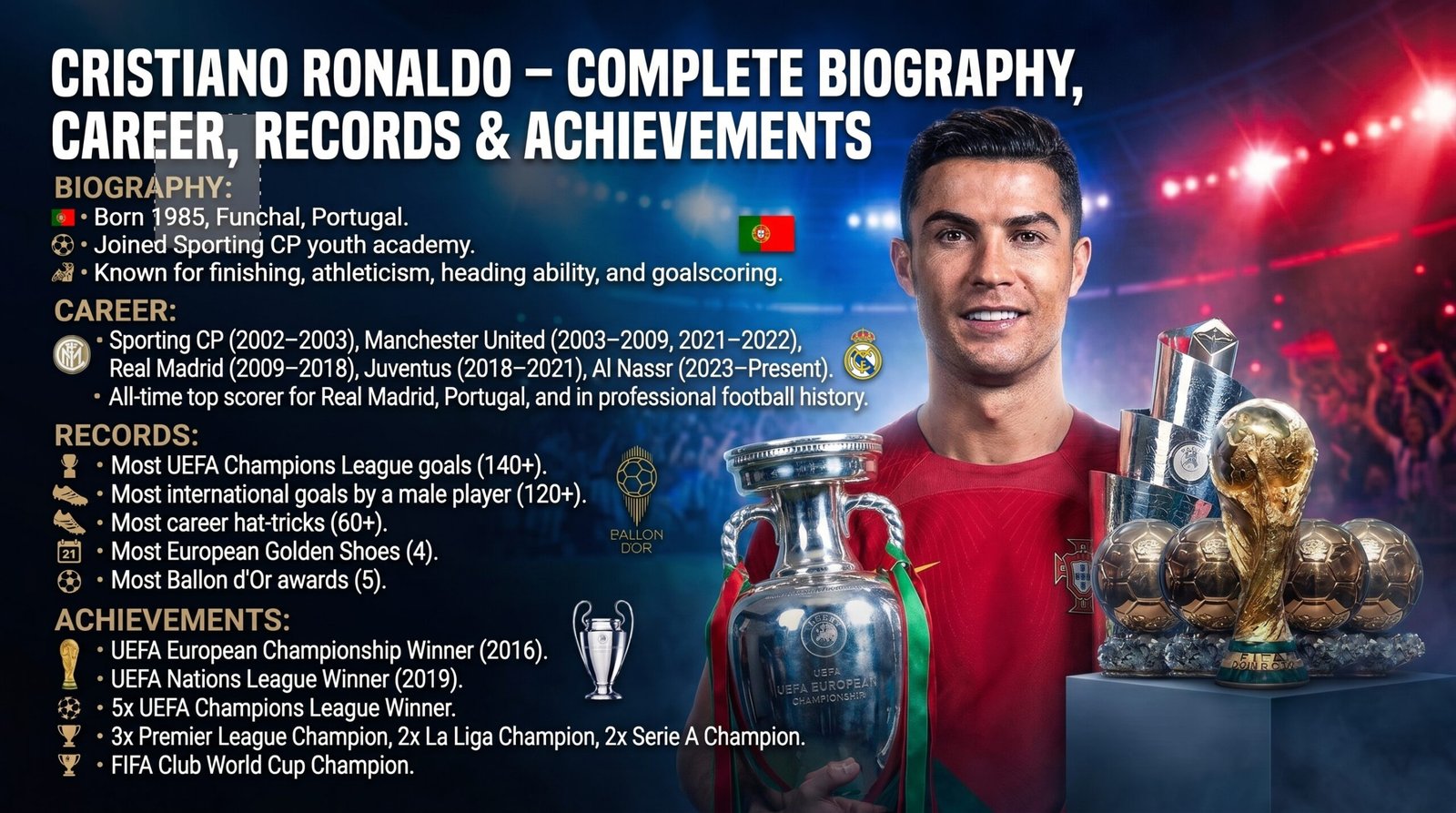
Introduction
Cristiano Ronaldo dos Santos Aveiro stands as a monolithic figure in the history of global sports. A name synonymous with sheer willpower, unprecedented athletic longevity, and an insatiable hunger for goalscoring, Ronaldo has spent over two decades completely redefining what is possible on a football pitch. From his humble beginnings on a small Portuguese island to dominating the grandest stages in European and world football, his journey is a masterclass in dedication. By the mid-2020s, Ronaldo had firmly established himself as the highest official goalscorer in the history of the sport, shattering records that stood for generations and pushing the boundaries of human endurance.
As of 2026, at the age of 41, Cristiano Ronaldo continues to actively compete at the highest level of international football. During the 2026 FIFA World Cup, he achieved yet another monumental milestone by scoring against Croatia in the knockout stages, taking his career tally to an astonishing 976 official goals. This relentless pursuit of the mythical 1,000-goal mark underscores a career built not just on natural talent, but on a superhuman work ethic. His influence extends far beyond the pitch; he is a global brand, a philanthropist, a cultural icon, and an inspiration to millions. This comprehensive biography delves deep into every facet of his extraordinary life, exploring the triumphs, the challenges, and the indomitable spirit of a true sporting legend.
Early Life and Childhood
Born on February 5, 1985, in the Sao Pedro parish of Funchal, the capital of the Portuguese island of Madeira, Cristiano Ronaldo’s origins were incredibly modest. He grew up in the impoverished neighborhood of Santo Antonio, in a small tin-roofed home that offered little in the way of comfort or luxury. Life was a constant struggle for the family, with financial resources stretched to the absolute limit. Despite the economic hardship, the community was tightly knit, and the streets of Santo Antonio served as the crucible where a young Ronaldo would first forge his relationship with the football.
Ronaldo’s childhood was not without severe physical challenges. At the age of 15, while already showing immense promise in his youth career, he was diagnosed with tachycardia, a condition that caused his resting heart rate to beat abnormally fast. This condition could have easily forced him to abandon his athletic dreams, as it posed a significant risk of sudden cardiac arrest during intense physical exertion. Fortunately, advanced medical intervention was possible. He underwent a precise laser surgery to cauterize the multiple cardiac pathways causing the issue. Remarkably, just days after the heart surgery, a teenage Ronaldo was back on the training pitch, completely unfazed and more determined than ever to succeed.
Family Background
Family has always been the cornerstone of Cristiano Ronaldo’s life. He is the youngest of four children born to Maria Dolores dos Santos Viveiros da Aveiro, a cook, and Jose Dinis Aveiro, a municipal gardener and part-time kit man. He has an older brother, Hugo, and two older sisters, Elma and Liliana Catia. His mother, Dolores, was the bedrock of the family, working exhausting hours in local kitchens to ensure her children had food on the table. Her unwavering support and sacrifices during Ronaldo’s early years formed a deep, unbreakable bond between mother and son that remains highly visible to this day.
His relationship with his father, Dinis, was complex and profoundly impactful. Dinis introduced Cristiano to the world of football, securing him his first youth club placement. However, Dinis battled severe alcoholism, a demon that cast a long shadow over the family’s life. Tragically, Dinis passed away in 2005 at the age of 52 due to a liver condition related to his drinking. Ronaldo was only 20 at the time, just beginning to make his mark at Manchester United. The loss of his father left a deep emotional scar, driving Ronaldo to abstain entirely from alcohol throughout his life and fueling his desire to become the absolute best in the world as a tribute to the man who first believed in him.
Growing Up in Madeira, Portugal
Madeira, a picturesque volcanic island situated in the North Atlantic Ocean, offered a rugged and isolated backdrop for Ronaldo’s formative years. Long before he played on the manicured grass of Europe’s elite stadiums, Ronaldo honed his skills on the steep, uneven concrete streets of Funchal. He would play with older boys, learning how to protect the ball, develop his close control, and utilize his rapid acceleration to avoid physical challenges. The makeshift matches often involved using bundled-up rags or deflated balls, forcing him to develop an exquisite touch and a relentless competitive edge.
His formal introduction to organized football began at the age of seven when he joined local club Andorinha, where his father worked as a kit man. His prodigious talent was immediately evident, earning him the nickname “crybaby” because he would become intensely emotional when his teammates failed to pass him the ball or if his team lost. By the age of ten, he signed with Nacional, one of the biggest clubs on the island. After a highly successful two-year spell at Nacional, where his reputation began to spread beyond the island, he was invited for a three-day trial with Sporting CP, one of Portugal’s premier footballing institutions. The trial would change his life forever.
Sporting CP Youth Academy
Leaving the familiar shores of Madeira for the sprawling metropolis of Lisbon at the tender age of 12 was a traumatic experience for the young Cristiano. Relocating to the Sporting CP youth academy, famously known as the Academia Sporting, he suffered from extreme homesickness. He was frequently mocked by his peers from the mainland for his distinct Madeiran accent, leading to frequent emotional outbursts and tearful phone calls begging his mother to let him return home. However, his extraordinary talent on the pitch shielded him from failure, and he channeled his isolation into an obsessive dedication to training.
By the age of 16, Ronaldo’s development was completely unprecedented. He achieved the rare distinction of playing for the club’s under-16, under-17, under-18, B-team, and first team all within a single season—a testament to his rapid physical maturation and undeniable skill. First-team manager Laszlo Boloni was mesmerized by his dribbling ability and immediately promoted him. On August 6, 2003, Sporting CP inaugurated their new Estadio Jose Alvalade with a pre-season friendly against the reigning English champions, Manchester United. A mesmerizing 18-year-old Ronaldo tormented the United defense, leaving seasoned professionals in awe. The performance was so spectacular that the United players pleaded with their manager to sign the young Portuguese winger before they even boarded the flight back to England.
Manchester United Career
In August 2003, Manchester United acquired Cristiano Ronaldo for a fee of 12.24 million pounds, making him the most expensive teenager in English football history at the time. Upon his arrival, he requested the number 28 shirt, the number he wore at Sporting, out of a desire to avoid the crushing pressure of the club’s legendary number 7 shirt—previously worn by icons like George Best, Eric Cantona, and David Beckham. However, manager Sir Alex Ferguson insisted he take the number 7, a massive vote of confidence that signaled the manager’s belief that Ronaldo was destined for greatness.
His early years at Old Trafford were characterized by raw, unpolished brilliance. He was often criticized for excessive showboating, unnecessary step-overs, and a lack of final product. However, a turning point occurred following the 2006 FIFA World Cup, where he was heavily vilified by the English press following a controversial incident involving his club teammate Wayne Rooney. Returning to England under immense hostility, Ronaldo transformed the vitriol into motivation. He bulked up significantly, eliminated unnecessary flair from his game, and focused ruthlessly on end product. The 2007-2008 season saw his ultimate evolution; he scored a staggering 42 goals across all competitions, leading United to domestic and European glory, and fundamentally changing the expectations for a wide midfielder.
Sir Alex Ferguson’s Influence
The relationship between Cristiano Ronaldo and Sir Alex Ferguson transcended the typical dynamic of a player and manager. For a young man who had lost his father at a crucial juncture in his life, the legendary Scottish manager became a surrogate father figure. Ferguson provided the perfect environment for Ronaldo to flourish, balancing strict discipline with an unwavering belief in the player’s extraordinary potential. Ferguson protected him from the notoriously aggressive British tabloid press, nurtured his confidence, and meticulously guided his tactical evolution from a pure winger into a devastating forward.
One of the most poignant examples of Ferguson’s profound impact occurred during the prolonged illness of Ronaldo’s father. Despite being in the middle of a crucial phase of the season, Ferguson granted Ronaldo unlimited compassionate leave, telling him that family was always more important than football. This gesture of immense empathy cemented a lifelong loyalty. Even decades later, long after Ronaldo had left Manchester United to conquer other leagues, he consistently referred to Ferguson as the most important figure in his professional career, affectionately calling him “the boss” and crediting him for instilling the relentless winning mentality that defined his career.
Premier League Success
Cristiano Ronaldo’s impact on the English Premier League was nothing short of revolutionary. During his prime years at Manchester United, he was the driving force behind a team that completely dominated English football. Between 2006 and 2009, United secured three consecutive Premier League titles, a feat that highlighted their total supremacy. Ronaldo was the focal point of a terrifying attacking trident alongside Wayne Rooney and Carlos Tevez, an attacking combination that blended ferocious work rate with sublime technical ability.
His individual dominance during this period was absolute. He won the PFA Players’ Player of the Year award twice, the FWA Footballer of the Year twice, and claimed the Premier League Golden Boot in the 2007-2008 season with 31 goals in 34 league appearances. He introduced a new paradigm to the league; prior to Ronaldo, wide players were primarily expected to provide assists for traditional strikers. Ronaldo inverted this dynamic, becoming the primary goalscorer from a wide position, utilizing his blistering pace, aerial dominance, and an unstoppable knuckleball free-kick technique that left Premier League goalkeepers completely bewildered.
UEFA Champions League Victories
If there is one competition that defines the legacy of Cristiano Ronaldo, it is the UEFA Champions League. He is the undisputed king of Europe’s premier club competition. His first taste of ultimate glory came with Manchester United in 2008. In a dramatic final against Chelsea in Moscow, Ronaldo scored a towering header to open the scoring. Although he missed his penalty in the ensuing shootout, United emerged victorious, granting Ronaldo his first Champions League medal and cementing his status as the best player in the world at the time.
However, it was at Real Madrid where his relationship with the Champions League reached mythical proportions. He was the catalyst for “La Decima”—Real Madrid’s obsession with winning their tenth European Cup—scoring a record-breaking 17 goals in the 2013-2014 Champions League campaign. But the pinnacle of his European dominance occurred under manager Zinedine Zidane, where Ronaldo led Madrid to an unprecedented three consecutive Champions League titles in 2016, 2017, and 2018. During this era, he repeatedly produced superhuman performances in the knockout stages, dismantling the greatest defenses in Europe single-handedly and finishing as the tournament’s top scorer year after relentless year.
Real Madrid Era
In the summer of 2009, Cristiano Ronaldo completed a world-record transfer to Real Madrid for a fee of 80 million pounds. His presentation at the Santiago Bernabeu stadium was attended by over 80,000 fanatical supporters, a visual testament to the colossal expectations placed upon his shoulders. Over the next nine years, Ronaldo did not just meet those expectations; he obliterated them. He transformed from a dynamic winger into an apex predator inside the penalty box, becoming the most lethal and consistent goalscorer in the history of the legendary Spanish club.
The statistics from his time in the Spanish capital defy logic. In 438 official appearances for Real Madrid, Ronaldo scored an incomprehensible 450 goals, averaging more than a goal per game over a nine-year span. He surpassed club legends like Alfredo Di Stefano and Raul to become Real Madrid’s all-time leading goalscorer. During this era, he engaged in a monumental rivalry with Barcelona’s Lionel Messi, a duel that elevated both players to unprecedented heights. Ronaldo won four of his five career Ballon d’Or awards while wearing the pristine white of Madrid, cementing a legacy that will forever echo through the halls of the Bernabeu.
Juventus Career
Seeking a new challenge and looking to conquer a third major European league, a 33-year-old Cristiano Ronaldo transferred to Italian giants Juventus in July 2018 for a fee of 100 million euros. The move sent shockwaves through the footballing world, proving his enduring commercial and athletic value even in the later stages of a traditional footballer’s career. His arrival in Turin immediately elevated the profile of Serie A, bringing a massive influx of global viewership, sponsorship revenue, and prestige back to Italian football.
On the pitch, Ronaldo adapted quickly to the notoriously tactical and defensively rigorous nature of Italian football. In his three seasons with Juventus, he won two Serie A titles and a Coppa Italia, maintaining an elite goalscoring rate. He scored 101 goals in 134 appearances for the Bianconeri, becoming the fastest player in the club’s history to reach the 100-goal milestone. His time at Juventus was highlighted by several spectacular individual performances, most notably a sensational second-leg hat-trick against Atletico Madrid in the 2019 Champions League round of 16, single-handedly overturning a 2-0 first-leg deficit.
Return to Manchester United
The summer of 2021 witnessed one of the most romantic and highly anticipated transfers in football history when Cristiano Ronaldo agreed to return to Manchester United. The announcement essentially broke the internet, and his second debut at Old Trafford was an event of monumental proportions. He marked the occasion by scoring a clinical brace against Newcastle United, sending the stadium into a state of absolute delirium. Throughout the 2021-2022 season, Ronaldo frequently rescued a struggling United side, scoring crucial late winners in the Champions League group stages and finishing the season with 24 goals in all competitions.
However, the fairy-tale return ultimately soured during his second season under new manager Erik ten Hag. Finding himself relegated to a rotational role for the first time in his career, frustrations boiled over. The situation culminated in a highly explosive and unauthorized television interview with British broadcaster Piers Morgan, during which Ronaldo heavily criticized the club’s ownership, the manager, and the lack of infrastructural progress since his first departure. The fallout was immediate and severe, resulting in the mutual termination of his contract in November 2022, closing the book on his Manchester United career in a highly controversial fashion.
Al Nassr Career
In early 2023, Cristiano Ronaldo made a pioneering move that would completely alter the landscape of global football economics by signing with Saudi Pro League club Al Nassr. The transfer was viewed initially by some critics as a final lucrative payday, but Ronaldo’s arrival sparked a massive exodus of world-class talent from Europe to Saudi Arabia. By acting as the trailblazer, he instantly legitimized the Saudi Pro League, drawing unprecedented international broadcast rights and media coverage to the Middle East.
Far from resting on his laurels, Ronaldo approached his time in Saudi Arabia with the exact same ferocious intensity that characterized his time in Europe. By the summer of 2026, he had already amassed over 129 goals for Al Nassr, winning the Arab Club Champions Cup and consistently topping the league’s scoring charts. He embraced the culture, elevated the training standards of his teammates, and proved that even deep into his late thirties and early forties, his physical conditioning and predatory instincts remained razor-sharp, allowing him to continue his march toward the 1,000 career goals milestone.
Portugal National Team
Representing the Portuguese national team has always been Cristiano Ronaldo’s greatest source of pride. He made his senior international debut in August 2003 against Kazakhstan and was quickly integrated into a “Golden Generation” squad featuring legends like Luis Figo and Rui Costa. Following their retirement, Ronaldo assumed the captain’s armband in 2008, taking on the monumental responsibility of carrying the hopes of his nation. Over a career spanning more than two decades, he has completely rewritten the record books of international football.
By 2026, Ronaldo had amassed an unbelievable 143 international goals, establishing himself as the greatest goalscorer in the history of men’s international football by a massive margin. He surpassed Iranian legend Ali Daei’s previous record of 109 goals in 2021 and simply never looked back. His international career is a story of immense perseverance; he endured heartbreaking defeats in the early years but continued to answer the call for his country, transforming Portugal from a team capable of deep tournament runs into actual champions.
UEFA Euro 2016
The defining moment of Cristiano Ronaldo’s international career occurred during the UEFA Euro 2016 tournament held in France. The campaign was grueling; Portugal struggled through the group stages, drawing all three matches, with Ronaldo rescuing the team via a vital brace against Hungary. As the tournament progressed into the knockout stages, his leadership proved essential. He scored a towering header in the semi-final against Wales, propelling Portugal into a highly anticipated final against the heavily favored host nation, France.
Tragedy struck just 25 minutes into the final when Ronaldo suffered a severe knee injury following a heavy challenge. Tears streaming down his face, he was stretchered off the pitch, and it appeared Portugal’s hopes were dashed. However, what followed cemented his legend. Unable to play, he emerged from the locker room with a heavily bandaged knee and effectively acted as an assistant manager alongside Fernando Santos. Barking orders, encouraging his teammates, and limping along the touchline, he willed his team forward. When Eder scored the winning goal in extra time, Ronaldo’s explosive celebrations showcased the raw emotion of a man who had finally delivered a major international trophy to his homeland.
UEFA Nations League
Following the historic triumph at Euro 2016, Ronaldo continued to guide Portugal to further international success. In 2019, Portugal hosted the inaugural finals of the UEFA Nations League. In the semi-final against a strong Swiss team, Ronaldo delivered an absolute masterclass. With the game tied at 1-1 late in the second half, he scored two stunning late goals to complete a sensational hat-trick, single-handedly dragging his team into the final.
In the final held at the Estadio do Dragao in Porto, Portugal faced a formidable Netherlands squad. While Ronaldo did not score in the final, his presence and leadership were vital as Portugal secured a hard-fought 1-0 victory through a goal by Goncalo Guedes. Lifting the Nations League trophy in front of his home fans added a second major piece of international silverware to his collection, emphatically silencing any remaining critics who previously claimed he could not achieve success on the international stage.
FIFA World Cup Appearances
Cristiano Ronaldo’s relationship with the FIFA World Cup is a remarkable tale of incredible longevity and persistent ambition. Making his debut in the 2006 tournament in Germany, a 21-year-old Ronaldo helped guide Portugal to the semi-finals, their best finish since 1966. Over the subsequent tournaments—2010 in South Africa, 2014 in Brazil, 2018 in Russia, and 2022 in Qatar—he consistently found the back of the net, ultimately becoming the first male player in history to score in five different World Cup tournaments.
The 2026 FIFA World Cup in North America represented a monumental chapter in his storied career. At 41 years old, playing in an unprecedented sixth World Cup, Ronaldo continued to defy time. During the Round of 32 clash against Croatia, he vanquished one of the few lingering criticisms of his career: a lack of knockout stage goals in the World Cup. He calmly converted a crucial penalty, securing a victory for Portugal and notching his 11th overall World Cup goal. This historic strike elevated his career goal tally to 976, keeping the dream of 1,000 career goals intensely alive on the grandest stage of all.
Playing Style
The evolution of Cristiano Ronaldo’s playing style is a prime example of his profound footballing intelligence. In his youth and early days at Manchester United, he was a traditional right-sided winger, heavily reliant on blinding pace, rapid step-overs, and erratic trickery. He was an entertainer who loved to isolate fullbacks and beat them with flair. However, as he matured and the physical demands of the game evolved, he transformed himself into the ultimate, highly efficient offensive machine.
During his prime at Real Madrid and into his later career, he transitioned into an inside forward and eventually a traditional number 9. His off-the-ball movement became his greatest asset; his ability to find pockets of space in crowded penalty areas borders on the supernatural. Athletically, he developed a jaw-dropping vertical leap, allowing him to hang in the air for extended seconds and generate immense power on his headers. Furthermore, his clinical ambidexterity—capable of striking the ball with lethal force using both his right and left foot—made him an absolute nightmare for defenders to corral. He evolved from a player who wanted the ball at his feet to a player who simply wanted the ball in the back of the net.
Training, Fitness and Diet
The secret behind Cristiano Ronaldo playing elite professional football into his 40s is his fanatical, almost monastic devotion to physical conditioning and diet. He views his body as an instrument that requires flawless maintenance. His training goes far beyond the standard club sessions; he utilizes a personal hyperbaric oxygen therapy chamber to accelerate tissue repair and frequently uses whole-body cryotherapy chambers, exposing himself to temperatures plunging below -160 degrees Celsius to drastically reduce muscle inflammation and speed up recovery.
His dietary discipline is legendary. He consumes a high-protein diet consisting largely of lean meats, fresh fish (especially swordfish and sea bass), whole grains, and fresh vegetables, strictly divided into up to six small meals throughout the day to maintain an optimal metabolism. He absolutely refuses to consume refined sugars, processed foods, or alcohol. Furthermore, rather than taking a traditional full night’s sleep, he follows a polyphasic sleep pattern recommended by a specialized sleep coach, taking up to five 90-minute restorative naps in fetal position on fresh linens throughout a 24-hour cycle. This extraordinary regimen is the sole reason for his unprecedented athletic longevity.
Business Ventures
Beyond the boundaries of the football pitch, Cristiano Ronaldo has built a massive, highly diversified corporate empire. Recognizing early on that a football career is finite, he leveraged his immense global fame to establish a portfolio of successful businesses. At the core of this is the Pestana CR7 hotel chain, a joint venture with the Portuguese Pestana Hotel Group, featuring luxury lifestyle hotels in prime locations such as Funchal, Lisbon, Madrid, New York, and Marrakech.
His investments also heavily focus on health and wellness, industries deeply aligned with his personal brand. He is a major stakeholder and co-founder of Insparya, a leading clinical group specializing in hair transplants with advanced facilities across Spain, Portugal, and Italy. Additionally, he partnered with US-based Crunch Fitness to launch a chain of “CR7 Fitness” gyms globally. In 2023, he expanded his portfolio into the beverage industry by launching URSU9, a brand of naturally alkaline mineral water sourced from Spain, promoting optimal hydration and health.
CR7 Brand
The “CR7” moniker is far more than just a nickname; it is one of the most recognizable and lucrative commercial brands on the planet. Originating simply from his initials and his iconic jersey number, the brand encompasses a vast array of consumer products. It began with a successful premium underwear line and quickly expanded into a comprehensive fashion label featuring denim, footwear, and high-end eyewear. He also has a highly successful line of bespoke fragrances, “CR7 Fragrances,” which consistently rank among the top-selling celebrity scents globally.
However, the cornerstone of the CR7 commercial juggernaut is his relationship with Nike. In 2016, Ronaldo signed a lifetime contract with the American sportswear giant, a monumental deal estimated to be worth over one billion dollars, putting him in an exclusive tier previously occupied only by basketball legends Michael Jordan and LeBron James. For nearly two decades, he has been the global face of the Nike Mercurial football boot, generating billions in revenue for the company and ensuring his brand visibility remains ubiquitous on every continent.
Charity and Philanthropy
While his on-pitch persona can sometimes be perceived as arrogant or fiercely individualistic, Cristiano Ronaldo is recognized behind the scenes as one of the most generous philanthropists in the sporting world. He does not have a single tattoo on his body, a deliberate choice he made specifically so he can donate blood and bone marrow regularly. Over the course of his career, he has quietly donated millions of dollars to hospitals, cancer research centers, and disaster relief funds worldwide.
His individual acts of kindness are well documented, though rarely publicized by the man himself. He has repeatedly paid the full costs for specialized surgeries and cancer treatments for critically ill children whose families reached out to him. In a notable instance in 2017, he auctioned off one of his actual Ballon d’Or replica trophies, raising hundreds of thousands of pounds for the Make-A-Wish Foundation. He has also served as a global ambassador for major organizations such as Save the Children, World Vision, and UNICEF, actively using his unparalleled global platform to advocate for childhood health and education initiatives in developing nations.
Personal Life
Cristiano Ronaldo is a deeply devoted family man. He is a father to five children. His first son, Cristiano Jr., was born in 2010 in the United States; Ronaldo maintains full custody and has never publicly revealed the identity of the mother, per an agreement between them. In June 2017, he welcomed twins, a boy named Mateo and a girl named Eva, born via a surrogate mother in the United States.
Since 2016, Ronaldo has been in a committed relationship with Spanish-Argentine model and influencer Georgina Rodriguez. The couple met while Georgina was working as a sales assistant at a Gucci retail store in Madrid. Together, they have two daughters: Alana Martina, born in November 2017, and Bella Esmeralda, born in April 2022. Tragically, Bella’s twin brother, Angel, passed away during childbirth, an incredibly difficult loss that Ronaldo cited as the hardest moment of his life since the death of his father. The family unit is tight-knit, frequently traveling the globe together and providing the emotional anchor that allows Ronaldo to perform at an elite level.
Social Media Influence
In the digital age, Cristiano Ronaldo’s influence is completely unmatched. He is not merely a sports star; he is the most followed human being on social media globally. As of the mid-2020s, his Instagram account alone surpassed 600 million followers, dwarfing the digital reach of any actor, musician, or politician on Earth. His combined following across Instagram, Facebook, and X (formerly Twitter) approaches one billion people, giving him a direct broadcasting platform larger than most global media conglomerates.
This unprecedented digital footprint is heavily monetized. It is widely reported that Ronaldo commands millions of dollars for a single sponsored social media post. Brands are willing to pay astronomical fees because an endorsement from Ronaldo guarantees instant global visibility and massive consumer engagement. Despite the heavy commercialization of his feeds, he effectively uses his social media to provide fans with highly curated glimpses into his training routines, family vacations, and behind-the-scenes moments, maintaining a deep parasocial connection with his massive global fanbase.
Career Statistics
The statistical output of Cristiano Ronaldo is a testament to an era-defining level of sustained brilliance. Spanning over two decades, playing across four different elite domestic leagues (Portugal, England, Spain, Italy) and the rapidly expanding Saudi Pro League, his numbers defy historical precedent. Below is a comprehensive breakdown of his official career goals as of his involvement in the 2026 FIFA World Cup. His total official tally stands at a staggering 976 goals, making him the most prolific goalscorer in the recorded history of professional football.
| Team / Country | Period | Official Goals | Major Role |
|---|---|---|---|
| Sporting CP | 2002 – 2003 | 5 | Breakout Academy Star |
| Manchester United | 2003–2009, 2021–2022 | 145 | Winger to Elite Forward |
| Real Madrid | 2009 – 2018 | 450 | Apex Goalscorer / Club Legend |
| Juventus | 2018 – 2021 | 101 | Veteran Attacker |
| Al Nassr | 2023 – Present | 129 | League Pioneer / Captain |
| Portugal National Team | 2003 – Present | 143 | All-Time Top International Scorer |
| Total Career Goals | 2002 – 2026 | 976 | Highest in Football History |
Records
The sheer volume of records held by Cristiano Ronaldo is almost too vast to fully catalogue. He has spent a career dismantling historical markers, often breaking records previously thought to be completely unassailable. His name is permanently etched at the very summit of the sport’s most prestigious statistical categories.
- Most Official Goals in Football History: Holds the Guinness World Record for the most officially recognized goals scored in senior football (976+).
- All-Time Leading Men’s International Goalscorer: Surpassed Ali Daei’s record, achieving 143 official goals for Portugal by 2026.
- Most International Appearances: Holds the record for the most highly capped male player in the history of international football.
- UEFA Champions League All-Time Top Scorer: Scored 140 goals in the competition proper.
- Most Goals in a Single UEFA Champions League Season: Scored 17 goals during the 2013-2014 campaign for Real Madrid.
- First Player to Score in Six FIFA World Cups: Found the net in 2006, 2010, 2014, 2018, 2022, and 2026.
- First Player to Score in Five UEFA European Championships: Scored in 2004, 2008, 2012, 2016, and 2020 (played in 2021).
- Real Madrid’s All-Time Leading Goalscorer: Scored 450 goals in just 438 appearances for the Spanish club.
- First Player to Win League Titles in England, Spain, and Italy: Conquered the Premier League, La Liga, and Serie A.
- Only Player to Score 50+ Goals in Seven Consecutive Calendar Years: Achieved this monumental feat from 2011 to 2017.
Awards and Honors
Ronaldo’s individual and team accolades form a glittering mountain of precious metal. He has won virtually every major collective trophy available in club and international football, alongside a staggering collection of the most coveted individual awards recognized by the global footballing community.
| Award / Trophy | Total Won | Details / Years |
|---|---|---|
| Ballon d’Or | 5 | 2008, 2013, 2014, 2016, 2017 |
| European Golden Shoe | 4 | 2007-08, 2010-11, 2013-14, 2014-15 |
| The Best FIFA Men’s Player | 2 | 2016, 2017 |
| UEFA Champions League | 5 | 2008 (Man Utd), 2014, 2016, 2017, 2018 (Real Madrid) |
| Premier League Titles | 3 | 2006-07, 2007-08, 2008-09 |
| La Liga Titles | 2 | 2011-12, 2016-17 |
| Serie A Titles | 2 | 2018-19, 2019-20 |
| UEFA European Championship | 1 | 2016 (Portugal) |
| UEFA Nations League | 1 | 2019 (Portugal) |
| FIFA Puskas Award | 1 | 2009 (For his 40-yard strike vs FC Porto) |
Greatest Goals
With nearly a thousand goals to his name, selecting the greatest is a subjective and daunting task. However, a few strikes stand out as pure masterpieces of athletic capability. The first is his Puskas Award-winning goal against FC Porto in the 2009 Champions League quarter-final. Receiving the ball nearly 40 yards out, he unleashed an absolute thunderbolt that clocked over 64 mph, arrowing into the top corner and leaving the goalkeeper rooted to the spot.
Yet, the pinnacle of his aesthetic brilliance occurred in Turin in 2018 against his future club, Juventus. In the Champions League quarter-final, Dani Carvajal lofted a cross into the box. Running away from the goal, Ronaldo launched himself into the air, connecting with a flawlessly executed bicycle kick at an astonishing height of nearly eight feet. The connection was so perfect, and the athletic execution so flawless, that the home Juventus fans rose to their feet to give the opposing player a standing ovation. Additionally, his dramatic, late curling free-kick against Spain in the 2018 World Cup to complete a brilliant hat-trick remains one of the most clutch goals in international history.
Memorable Matches
Ronaldo is the ultimate big-game player, capable of taking a match by the scruff of the neck when the stakes are highest. In 2013, Portugal faced Sweden in a tense two-legged playoff to qualify for the 2014 World Cup. Billed as a heavyweight clash between Ronaldo and Zlatan Ibrahimovic, Ronaldo delivered a masterclass. In the second leg in Solna, he scored a devastating second-half hat-trick, answering Ibrahimovic’s brace with terrifying pace and clinical finishing to drag his country to Brazil.
Another monumental display of willpower came in the 2015-2016 Champions League quarter-finals. Real Madrid had suffered a shocking 2-0 defeat to VfL Wolfsburg in the first leg in Germany. Facing elimination at the Bernabeu, Ronaldo promised the fans a magical night. He delivered exactly that, scoring a rapid-fire brace in the first half to level the tie, and then completing his hat-trick with a precision free-kick in the 77th minute. He repeated a nearly identical heroic rescue act three years later for Juventus, overturning a 2-0 deficit against Atletico Madrid with a towering hat-trick that highlighted his sheer refusal to accept defeat.
Rivalry with Lionel Messi
The story of modern football cannot be written without a central focus on the epic, 15-year rivalry between Cristiano Ronaldo and Lionel Messi. It is widely considered the greatest individual rivalry in the history of team sports. Playing on opposite sides of the bitter El Clasico divide for nearly a decade, the two players engaged in a relentless arms race, pushing each other to statistical heights previously thought completely impossible. They monopolized the Ballon d’Or for a decade, scoring 50 to 60 goals a season as a baseline standard.
While often contrasted in stylistic terms—Messi portrayed as the naturally gifted, diminutive genius, and Ronaldo as the ultimate, self-made athletic machine—both narratives are somewhat reductive. Both possess immense natural talent and extraordinary work ethics. Despite the fierce media narratives that often attempted to pit them against one another on a personal level, a deep mutual respect developed between the two legends over the years. They have frequently acknowledged publicly that the presence of the other forced them to continually evolve and improve, resulting in a golden era of football that fans were profoundly privileged to witness.
Legacy
Cristiano Ronaldo’s legacy extends far beyond the vast array of trophies and the mind-boggling statistical records. He fundamentally changed the culture of professional football. Before Ronaldo, immense natural talent was often considered enough. Ronaldo proved that talent must be paired with an obsessive, 24/7 dedication to physical fitness, diet, and recovery. He became the absolute blueprint for the modern elite athlete. Today, a new generation of superstars, including Kylian Mbappe and Erling Haaland, cite Ronaldo’s mentality and professionalism as their primary inspiration.
Furthermore, his global impact is undeniable. The mere act of performing his iconic “Siuuu” celebration is a universal language, mimicked by children on playgrounds from Tokyo to Buenos Aires, and even adopted by athletes in entirely different sports. By pioneering the movement of top-tier talent to the Middle East late in his career, he reshaped the geopolitical landscape of football economics. Ultimately, Cristiano Ronaldo will be remembered as a man whose self-belief was a literal force of nature, a player who squeezed every single ounce of potential out of his body to write his name into the annals of immortality.
20 Interesting Facts
- Named After a President: His second name, Ronaldo, was chosen in honor of the then-US President Ronald Reagan, who was his father’s favorite actor.
- No Tattoos for a Reason: Unlike many modern footballers, Ronaldo refuses to get any tattoos so that he can continually donate blood and bone marrow without waiting periods.
- A Heart Condition: At age 15, he underwent laser surgery to correct a racing heart condition that could have ended his football career before it even began.
- Expelled from School: He was expelled from school at the age of 14 after throwing a chair at a teacher who he claimed had “disrespected” him, prompting his mother to let him focus entirely on football.
- The “CR7” Galaxy: In 2015, a group of astronomers discovered a new galaxy and named it Cosmos Redshift 7 (CR7), inspired by Ronaldo’s iconic brand.
- University Subject: The University of British Columbia Okanagan once offered a sociology course focused entirely on the global cultural impact of Cristiano Ronaldo.
- Teetotaler: He completely abstains from drinking alcohol, a strict personal rule deeply tied to the tragic death of his father from alcohol-related liver failure.
- First to Six World Cups: In 2026, he became the first male player in history to score goals in six different FIFA World Cup tournaments.
- Record-Breaking Jump: Sports scientists recorded his vertical leap at 71 cm (28 inches) during his prime, a jump higher than the average NBA basketball player.
- Airport Namesake: The international airport in his native Madeira was officially renamed to “Cristiano Ronaldo International Airport” in 2017.
- Lifetime Nike Deal: He is one of only three athletes in history (alongside Michael Jordan and LeBron James) to sign a “lifetime” contract with Nike.
- Most Followed Human: He holds the record for being the most followed individual on Instagram, possessing hundreds of millions of followers.
- Museum in his Honor: He owns and operates “Museu CR7” in his hometown of Funchal, Madeira, which houses his official trophies and memorabilia.
- A Generous Gift: When his long-time agent Jorge Mendes got married, Ronaldo reportedly bought him an entire Greek island as a wedding present.
- Billion Dollar Athlete: He was the first active team-sport athlete to surpass one billion dollars in career earnings.
- Ambidextrous Finisher: He has scored over 150 career goals with his “weak” left foot, making him one of the most completely two-footed players in history.
- Scoring in Every Minute: He is one of the rare players in history to have scored a goal in every single minute (1 through 90) of a regulation football match throughout his career.
- Home Cryotherapy: He installed a customized, 50,000-pound cryotherapy chamber in his home to aid in rapid muscle recovery after intense matches.
- Paying for Surgeries: He secretly paid the full $83,000 medical bill for a 10-month-old fan requiring complex brain surgery in 2014.
- Refuses to Swap Shirts Early: He has a strict policy of never swapping shirts with an opposing player at half-time, preferring to only do so after the final whistle.